

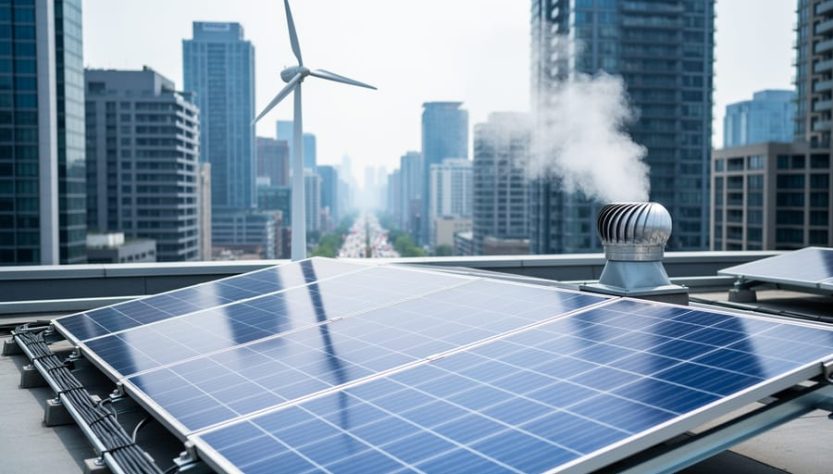
Renewable energy in cities refers to the generation and use of clean power from sources like solar, wind, geothermal, and biomass within dense urban environments where buildings, infrastructure, and millions of people compete for limited space. As of 2026, over 55% of the global population lives in urban areas, and cities consume roughly three-quarters of the world’s energy while producing a disproportionate share of greenhouse gas emissions. This concentration makes urban centers both critical contributors to climate change and essential frontiers for decarbonization.
Cities face unique challenges in deploying renewable energy systems. Vertical infrastructure restricts ground-level solar installations. Wind patterns shift unpredictably between tall buildings. Yet these same constraints have driven innovation in rooftop solar arrays, building-integrated photovoltaics, small-scale wind turbines designed for urban turbulence, and district heating systems that recover waste energy from industrial processes.
The transition to urban renewable energy matters because it addresses energy security, reduces air pollution that affects public health, and lowers municipal carbon footprints without requiring residents to abandon urban lifestyles. Cities like Copenhagen, San Francisco, and Singapore have demonstrated that dense populations and clean energy are not mutually exclusive.
This article explains how renewable energy functions in space-constrained urban settings, categorizes the technologies best suited to city deployment, examines real-world applications across residential and commercial sectors, and identifies the technical and regulatory challenges that still slow adoption. Whether you’re a policymaker drafting energy ordinances or a building manager evaluating solar feasibility, understanding how renewable systems adapt to urban contexts is essential for making informed infrastructure decisions.
What Renewable Energy in Cities Means
Renewable energy in cities refers to the generation and use of power from naturally replenishing sources, such as sunlight, wind, geothermal heat, and biomass, within densely populated urban environments. Unlike traditional energy systems that rely on fossil fuels transported from distant power plants, urban renewable energy involves producing clean power closer to where people actually live and work, often through rooftop solar panels, building-integrated systems, and neighborhood-scale installations.
This approach fundamentally differs from conventional urban energy supply in several ways. Traditional cities depend on large, centralized power stations located outside metropolitan areas, with electricity traveling through extensive transmission networks that lose energy over distance. Urban renewable systems flip this model by embedding generation capacity throughout the city fabric itself, on building rooftops, in community solar gardens, through waste-to-energy facilities, and via district heating networks that tap underground geothermal resources.
- Distributed Generation
- Energy production at or near the point of use, rather than at large, remote power plants. This reduces transmission losses and increases grid resilience.
- Microgrids
- Localized energy networks that can operate independently from the main grid, allowing neighborhoods or districts to maintain power during outages while optimizing renewable energy use.
- Urban Energy Density
- The amount of energy consumed per square kilometer in cities, which is significantly higher than rural areas due to concentrated populations and economic activity.
- Net-Zero Cities
- Urban areas that produce as much renewable energy as they consume annually, balancing energy use with clean generation to eliminate net carbon emissions from the power sector.
The shift to urban renewable energy introduces distinct challenges that don’t exist in rural or utility-scale projects. Cities have limited available space for solar arrays or wind turbines, forcing creative solutions like vertical installations and shared rooftop systems. High-rise buildings create turbulence and shade that complicate energy generation. Aging grid infrastructure often struggles to handle two-way power flows when buildings both consume and produce electricity. Coordinating thousands of small-scale renewable installations requires sophisticated management systems, while diverse building ownership and varied municipal regulations create implementation complexity that single large projects never face.
How Urban Renewable Energy Systems Work
Generation and Distribution
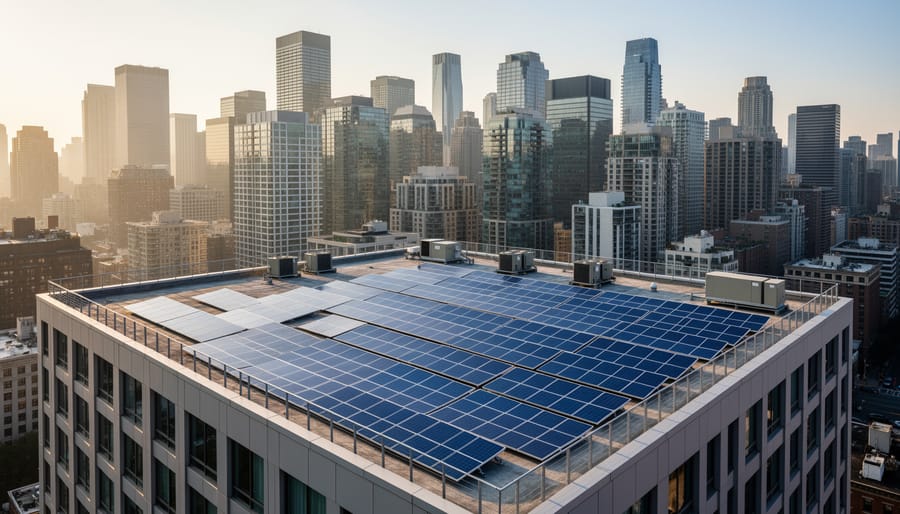
Cities generate renewable energy through multiple distributed systems that transform urban structures into power producers. Rooftop solar panels remain the most widespread technology, converting sunlight directly into electricity on residential buildings, warehouses, and commercial centers. A typical installation on a mid-rise apartment building can generate 50-100 kilowatts during peak hours, feeding power into the building’s internal system while excess production flows to the broader grid.
Building-integrated photovoltaics take this further by embedding solar cells into facades, windows, and architectural elements. These systems generate electricity continuously throughout the day as different building surfaces catch sunlight, turning the entire structure into an active energy generator rather than a passive consumer.
Urban wind turbines, though less common, capture air currents between buildings and along rooftops. Modern vertical-axis designs operate quietly at lower wind speeds than traditional turbines, making them viable in dense neighborhoods. A single rooftop installation might produce 5-20 kilowatts depending on local wind patterns.
District heating systems collect thermal energy from geothermal sources, industrial waste heat, or large-scale solar thermal arrays, then distribute hot water through insulated underground pipes to multiple buildings. This centralized approach proves especially efficient in colder climates, where one facility can serve entire neighborhoods.
The energy flows from these generation points through smart inverters and distribution panels into building electrical systems, supplying immediate demand. Surplus power travels through transformers to the municipal grid, where it offsets fossil fuel generation and can be drawn by other users across the city.
Grid Integration and Storage
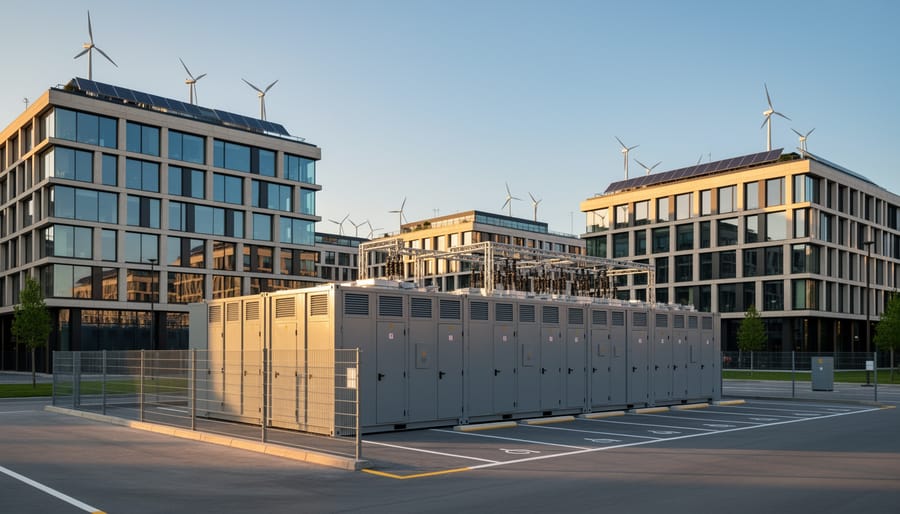
Urban renewable energy sources produce power intermittently, making grid integration a complex technical challenge. When solar panels generate electricity during peak sunlight or wind turbines spin during windy periods, that energy must either be consumed immediately, stored for later use, or fed back into the broader electrical grid. Cities address this through advanced grid management systems that continuously monitor supply and demand, automatically routing power where it is needed and preventing overloads.
Smart inverters play a critical role by converting the direct current from solar panels into alternating current compatible with grid infrastructure. These devices also communicate with grid operators, adjusting power flow in real time based on network conditions. Bidirectional energy flow allows buildings to draw electricity when needed and export surplus generation back to the grid, effectively turning individual structures into distributed power stations.
Energy storage solves the mismatch between when renewable power is generated and when it is needed. Large-scale battery installations, typically lithium-ion systems, store excess electricity during high production periods and discharge during evening peaks or cloudy days. Renewable storage tech has advanced significantly, with battery costs dropping and capacity increasing, making multi-hour storage economically viable for cities.
Beyond batteries, some urban areas use thermal storage, where excess renewable electricity heats water or other materials that release warmth gradually, reducing heating demands during non-generation hours. Grid-scale storage systems, often located at substations or alongside renewable installations, provide frequency regulation and backup power, ensuring stable electricity supply even when solar and wind output fluctuates.
Types of Renewable Energy Sources in Cities
Solar Energy
Solar panels on city buildings convert sunlight into electricity through photovoltaic cells, making them one of the most practical renewable options for urban areas. Rooftop installations are the most common approach, turning unused building surfaces into power generators. A typical residential rooftop system in a sunny climate can produce 4,000 to 8,000 kilowatt-hours annually, enough to cover a significant portion of a household’s energy needs. Commercial buildings with larger roof areas can generate substantially more.
Solar facades integrate panels directly into building exteriors, using vertical surfaces that would otherwise serve only structural purposes. While vertical panels produce 20 to 30 percent less energy than optimally-angled rooftop systems, they make use of space that rooftops alone cannot provide, particularly valuable on tall buildings with limited roof area relative to their energy demand.
Parking structures and lots are increasingly topped with solar canopies, which generate electricity while shading vehicles beneath. These installations turn vast expanses of asphalt into dual-purpose infrastructure without consuming additional land.
Community solar projects allow multiple households to share output from a single solar array, solving the problem for renters and residents whose buildings are unsuitable for individual installations.
Wind Energy
Wind energy presents unique opportunities and constraints in urban settings. Small-scale vertical-axis wind turbines can be mounted on rooftops or integrated into building designs, particularly in high-rise districts where wind speeds increase with elevation. These systems differ significantly from rural wind farms, operating on the same principles of how wind works but scaled down for constrained spaces and variable urban wind patterns.
Building-mounted turbines typically generate between 1 and 10 kilowatts, enough to offset a portion of a building’s energy consumption rather than provide complete power. They work best in coastal cities or locations with consistent wind corridors created by architectural layouts. Noise remains a legitimate concern, though newer designs with improved bearings and blade configurations have reduced vibration and sound levels considerably.
For coastal metropolitan areas, offshore wind farms connected to urban grids offer far greater capacity, delivering utility-scale clean electricity without consuming valuable city real estate or creating noise issues for residents.
Geothermal and Waste-to-Energy
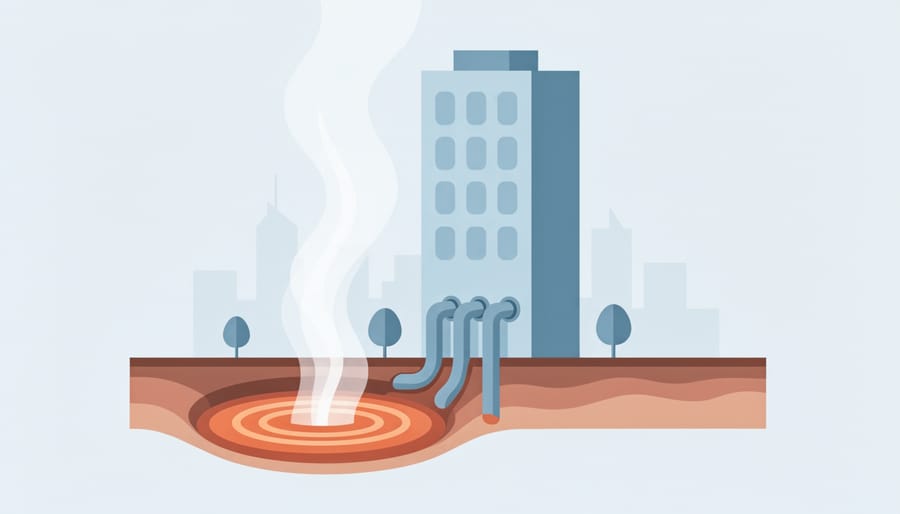
Geothermal systems tap into stable underground temperatures to heat and cool buildings with remarkable efficiency. Geothermal heat pumps circulate fluid through pipes buried beneath city parks, under building foundations, or in vertical boreholes, transferring heat between the earth and indoor spaces. These systems work in dense urban areas where horizontal ground loops fit under shared green spaces or parking lots. District geothermal networks take this concept further, connecting multiple buildings to a shared underground heat source and pairing it with thermal energy storage to balance loads across neighborhoods.
Waste-to-energy facilities convert municipal solid waste into electricity or district heating, addressing two urban challenges simultaneously. Modern plants use combustion or gasification to extract energy from trash that would otherwise fill landfills, supplying power to surrounding districts. Scalability depends on waste volumes and available land, compact incineration plants can serve a city block, while larger facilities process hundreds of tonnes daily. Both geothermal and waste-to-energy systems reduce reliance on fossil fuels while using resources cities already possess.
Hydropower and Emerging Technologies
Urban waterways offer untapped potential for renewable generation through micro-hydropower systems that harness flow in rivers, canals, and drainage channels. These compact turbines typically produce 5 to 100 kilowatts, enough to power streetlights, park facilities, or nearby buildings. While scaled-down compared to traditional dams, the question of is hydropower renewable applies equally to these urban installations, which generate electricity without depleting the water source.
Cities are also piloting kinetic energy capture from pedestrian traffic. Floor tiles embedded with piezoelectric materials convert footsteps into electricity at train stations and shopping districts, though current output remains modest, enough for LED displays but not building power. Other experimental systems include building-integrated algae bioreactors that produce biomass while filtering air, and vertical-axis turbines optimized for turbulent urban wind patterns. These technologies remain in early deployment stages, with costs and efficiency improvements needed before widespread adoption becomes practical.
Applications of Renewable Energy in Urban Settings
Residential and Commercial Buildings
Apartment complexes and office towers are increasingly embedding renewable energy systems directly into their design and operations. Rooftop solar panels represent the most common approach, with flat commercial roofs offering substantial generation capacity. In dense urban cores where roof space is limited, developers install building-integrated photovoltaics on facades and windows, turning exterior surfaces into power generators without sacrificing usable square footage.
Mixed-use developments benefit from economies of scale, combining residential, retail, and office spaces under shared renewable energy systems. These buildings often incorporate ground-source heat pumps for climate control and solar thermal arrays for hot water, reducing reliance on fossil fuel heating systems. Battery storage installed in basements or mechanical floors stores excess solar generation for evening use.
Building codes in leading cities now mandate renewable energy provisions for new construction above certain sizes. The International Green Construction Code and LEED certification programs push developers further, awarding credits for exceeding minimum renewable energy thresholds. Net-zero energy buildings, which generate as much power as they consume annually, are becoming standard for Class A office developments seeking premium tenants and higher valuations.
Transportation and Public Infrastructure
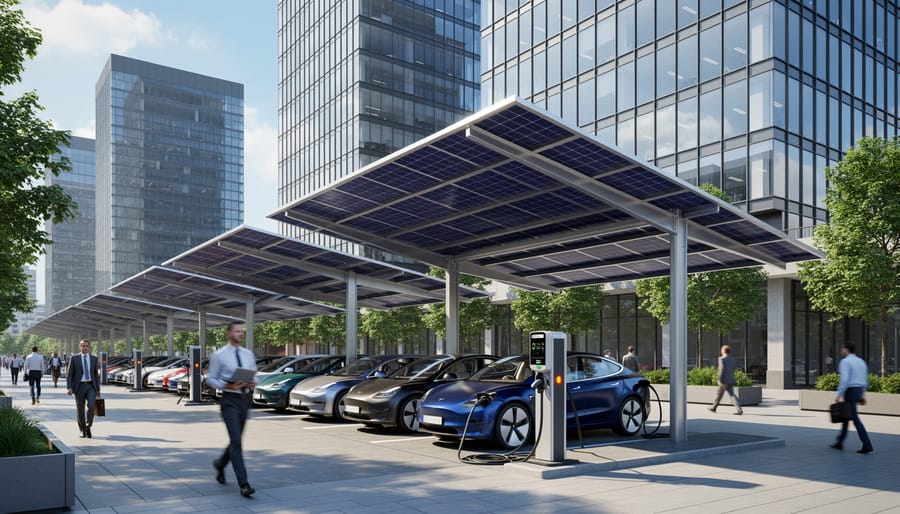
Cities are deploying renewable energy across their transportation networks and public infrastructure to reduce emissions and operating costs. Electric bus fleets increasingly run on electricity from municipal solar farms or wind contracts, while some transit agencies install solar panels on bus depot roofs to power charging stations directly. Light rail and metro systems are integrating renewable energy purchases into their operations, with several cities achieving 100% renewable-powered trains.
Solar-powered street lighting has become standard in new developments and retrofit projects. These systems use integrated solar panels and battery storage, eliminating grid connection costs and providing illumination during outages. LED technology makes the approach economically viable even in climates with moderate sun exposure.
EV charging infrastructure represents a growing application, with charging stations powered by on-site solar canopies or renewable energy credits. Airports and major transit hubs are installing extensive solar arrays on terminal roofs, parking structures, and adjacent land, generating substantial portions of their operational electricity. Some airports now function as small power plants, feeding excess renewable generation back to the city grid during off-peak hours.
District Energy Systems
District energy systems represent a shift from building-by-building energy production to neighborhood-scale infrastructure that serves multiple structures through shared networks. These systems pipe hot water, chilled water, or steam from a central plant to dozens or hundreds of buildings, allowing an entire district to benefit from large renewable installations that would be impractical at individual sites.
Modern district heating networks often draw from geothermal wells, large solar thermal arrays, or waste heat recovered from data centers and industrial facilities. In Scandinavian cities, biomass-fueled plants provide reliable baseload heating, while seasonal thermal storage in underground aquifers captures summer heat for winter use. District cooling systems circulate chilled water from central facilities using absorption chillers powered by solar thermal energy or lake-source cooling, eliminating the need for separate air conditioning units in every building.
Community microgrids take this concept further by creating localized electricity networks that can operate independently from the main grid. These microgrids combine rooftop solar across multiple buildings, shared battery storage, and intelligent control systems that optimize energy distribution. During grid outages, the microgrid maintains power to essential services, offering resilience alongside sustainability. The economics improve as more buildings join, spreading infrastructure costs and increasing the system’s overall efficiency.
Benefits and Challenges of Urban Renewable Energy
Cities worldwide are embracing renewable energy because it delivers measurable environmental, economic, and social gains. At the same time, the urban context creates distinct obstacles that require careful planning and sustained investment to overcome.
The most immediate benefit is the dramatic reduction in greenhouse gas emissions. Replacing fossil-fuel-based electricity with solar, wind, and other renewable sources cuts the carbon footprint of buildings, transportation, and municipal operations. Cities like Copenhagen and Vancouver have reduced emissions by 40 to 60 percent largely through renewable energy deployment, demonstrating that substantial progress is achievable within a decade or two. This shift also improves local air quality by reducing particulate matter and nitrogen oxides from combustion, which translates to fewer respiratory illnesses and lower healthcare costs.
Energy security is another powerful driver. Cities that generate their own renewable power become less vulnerable to price volatility in global fossil fuel markets and less dependent on distant power plants. Distributed generation, especially rooftop solar and neighborhood microgrids, creates resilience against grid failures and natural disasters. When a storm knocks out centralized infrastructure, buildings with on-site generation and battery storage can maintain critical services.
Economically, renewable energy creates local jobs in installation, maintenance, and energy management, while reducing long-term energy expenses for residents and businesses. Solar and wind have no fuel costs, so once the infrastructure is built, operating expenses are minimal. Cities can reinvest savings into other services or pass them on to ratepayers.
Yet challenges persist. Space is the defining constraint. Dense urban areas lack open land for large solar farms or wind installations, forcing reliance on rooftops, facades, and repurposed infrastructure that yield less energy per square meter than rural projects. Initial capital costs remain high, particularly for building retrofits and grid upgrades needed to handle decentralized, intermittent power sources. Many cities face outdated regulations that favor incumbent utilities, slow permitting processes, and rate structures that discourage distributed generation. Grid modernization, including smart meters and advanced energy management systems, demands significant public and private investment.
Balancing these trade-offs requires political will, innovative financing, and collaboration among utilities, developers, and residents to make urban renewable energy a practical reality.
Case Studies: Cities Leading in Renewable Energy
Section: Case Studies: Cities Leading in Renewable Energy
Target: ~400 words
Links: None required
Approach: Profile 3-4 cities with specific technologies, measurable outcomes, and varied strategies
—
Several cities worldwide have demonstrated that ambitious renewable energy targets are achievable even within dense urban constraints. Their experiences offer practical lessons for other municipalities.
Copenhagen, Denmark has positioned itself as a carbon neutrality pioneer, targeting net-zero emissions by 2025. The city generates substantial power from offshore wind farms in the Øresund strait, which supply approximately 40% of the metropolitan area’s electricity. Copenhagen also operates extensive district heating networks that utilize biomass, waste incineration, and industrial excess heat rather than fossil fuels. These combined systems now provide heating to 98% of city buildings through underground pipes. The municipality reports that renewable sources account for roughly 80% of district heating fuel, dramatically reducing residential and commercial carbon footprints. Copenhagen’s integrated approach shows how cities can leverage geography (coastal wind resources) alongside existing infrastructure (district heating pipes) to accelerate transitions.
Reykjavik, Iceland demonstrates geothermal energy’s potential where geological conditions allow. The city draws nearly 100% of its heating and hot water needs from geothermal reservoirs beneath the capital region. Five geothermal power plants tap into high-temperature underground water, which is then distributed through a 3,000-kilometer pipe network serving homes, businesses, and even sidewalk snow-melting systems. Iceland’s national grid, which powers Reykjavik, generates over 85% of total electricity from hydroelectric and geothermal sources combined. While Reykjavik benefits from exceptional natural resources unavailable to most cities, its comprehensive geothermal infrastructure illustrates how direct thermal energy can eliminate heating emissions entirely in suitable locations.
San Diego, California adopted a Climate Action Plan mandating 100% renewable electricity by 2035. The city has installed solar panels on municipal buildings including libraries, fire stations, and wastewater treatment facilities, generating over 40 megawatts of on-site solar capacity as of 2025. San Diego’s strategy emphasizes community solar gardens that allow residents without suitable rooftops to purchase shares in larger arrays. The city also requires new residential construction to include rooftop solar, a policy that has added thousands of distributed generation points across neighborhoods. San Diego reported that renewable sources provided 47% of citywide electricity in 2024, up from 33% five years earlier.
Shenzhen, China converted its entire public bus fleet of over 16,000 vehicles to electric operation by 2017, the world’s first major city to achieve this transition. The buses run on electricity from an increasingly renewable grid, with Shenzhen expanding solar installations on commercial and industrial rooftops. The city has demonstrated that electrifying transport at scale requires coordinating charging infrastructure, grid capacity upgrades, and renewable generation simultaneously.
Common Questions About Renewable Energy in Cities
Is renewable energy reliable enough to power a city during peak demand?
Yes, when cities combine multiple renewable sources with modern battery storage and smart grid technology that balances supply dynamically. Advanced forecasting and demand-response programs ensure stability even during high-consumption periods.
How much does it cost for a city to transition to renewable energy?
Initial infrastructure investment varies widely by city size and existing systems, but costs have dropped significantly as technology advances. Most cities see long-term savings through reduced fuel costs and maintenance, with payback periods typically ranging from seven to fifteen years depending on the technologies deployed.
Can existing buildings be retrofitted for renewable energy?
Absolutely. Older buildings can add rooftop solar panels, connect to district energy systems, or install ground-source heat pumps without major structural changes. Many cities now offer retrofit programs and incentives specifically designed for existing building stock.
How can residents participate in urban renewable energy programs?
Citizens can join community solar projects, invest in shared wind programs, participate in demand-response initiatives, or advocate for renewable energy policies through local government channels. Many cities also offer rebates for installing residential solar systems or switching to electric heating.
How long does it take for a city to complete a renewable energy transition?
Full transitions typically span fifteen to thirty years, though cities often achieve significant milestones within five to ten years. The timeline depends on political commitment, available funding, existing infrastructure, and the pace at which renewable energy trends enable more efficient deployment strategies.
What happens to renewable energy systems during extreme weather?
Modern systems are designed with resilience features including weatherproof equipment, backup storage, and distributed generation that maintains power even when individual components face disruption. Cities increasingly build redundancy into their renewable infrastructure to handle climate extremes.
These questions reflect the practical concerns voiced by both policymakers evaluating large-scale projects and residents wondering how urban renewable energy affects their daily lives. Cost considerations remain central, but the financial equation has shifted dramatically as equipment prices fall and operational savings accumulate over decades. The reliability question, once the primary objection to renewables, is now largely resolved through technology combinations rather than any single solution.
Participation matters because urban renewable energy works best as a shared infrastructure model rather than isolated installations. When multiple buildings connect to a district system or neighborhood microgrid, efficiency improves and costs distribute more equitably. Cities that create accessible entry points for residents, whether through community solar subscriptions or public consultations on energy planning, build both technical infrastructure and the social foundation needed for long-term success.
Cities stand at the forefront of the global transition to renewable energy, and their progress in 2026 demonstrates that urban sustainability is not just an aspiration but an achievable reality. The integration of solar, wind, geothermal, and emerging technologies into dense metropolitan areas has proven both technically feasible and economically viable, with thousands of cities worldwide now generating significant portions of their electricity from clean sources.
The transformation continues to accelerate as technologies improve, costs decline, and supportive policies multiply. Smart grid systems, advanced energy storage, and innovative district energy networks are removing the barriers that once made urban renewable deployment seem impractical. What began as isolated pilot projects has evolved into comprehensive citywide strategies that touch every sector from residential buildings to public transportation.
Success depends on sustained collaboration among municipal governments, utilities, private developers, community organizations, and residents. Cities that have achieved the most dramatic emissions reductions share a common approach: they combine ambitious targets with practical implementation plans, invest in infrastructure modernization, and engage citizens as active participants rather than passive consumers.
The urban energy landscape will look markedly different a decade from now, with renewable sources powering the majority of city functions in leading regions. Cities that act decisively today position themselves as healthier, more resilient, and economically competitive places to live and work. The clean energy transition is fundamentally an urban transition, and cities have both the motivation and the means to lead it.