

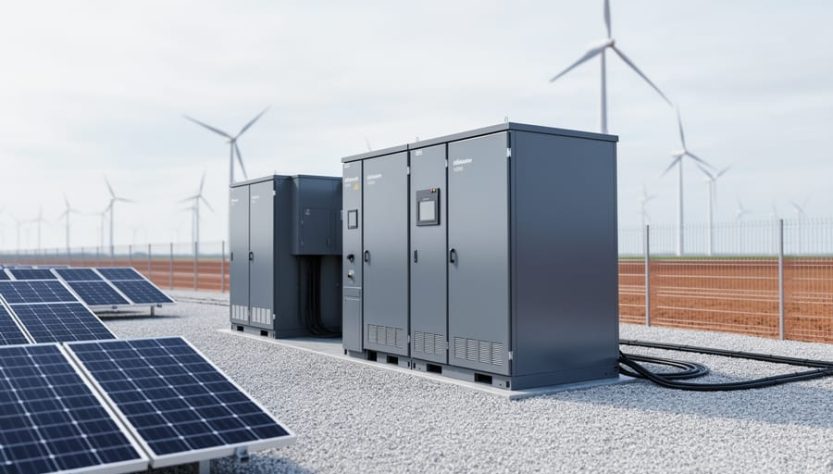
Energy storage technology captures electricity or other forms of energy and holds it for later use, enabling power to be consumed at a different time than when it was generated. This capability has become essential to the global transition toward renewable energy, solving one of clean power’s most fundamental challenges: the sun doesn’t always shine, and the wind doesn’t always blow. Without effective storage, solar panels and wind turbines can only supply electricity when conditions permit, forcing grids to rely on fossil fuel backup or curtail excess clean generation when demand is low.
The storage landscape has evolved dramatically. What began as simple pumped hydroelectric facilities in the early 20th century has expanded into a diverse ecosystem of technologies ranging from advanced lithium-ion batteries to gravity-based systems, thermal storage, and emerging innovations like liquid air energy storage. Each approach serves different needs, time scales, and economic contexts within the broader energy system.
Understanding renewable storage tech matters now more than ever. Global renewable capacity additions continue to accelerate, but without adequate storage infrastructure, much of that clean energy potential remains stranded or underutilized. Storage enables renewables to provide baseload power, stabilizes grid frequency, defers costly transmission upgrades, and allows households and businesses to maximize their solar investments through self-consumption.
This article provides a comprehensive foundation in energy storage technology. You’ll discover how different storage systems work at a mechanical level, explore the major technology categories deployed today, and understand real-world applications from grid-scale installations to residential backup systems. Whether you’re a policymaker evaluating storage incentives, a professional entering the clean energy sector, or simply curious about how we’ll power a carbon-free future, this guide delivers the clarity you need without unnecessary complexity.
What Energy Storage Technology Means
Energy storage technology refers to systems and methods that capture electrical energy when it is available and hold it in various forms until needed. At its core, these technologies solve a fundamental challenge: matching energy generation with energy consumption across time.
The process involves three key stages. First, the system converts incoming electrical energy into a storable form, chemical bonds in a battery, potential energy in elevated water, kinetic energy in a spinning flywheel, or thermal energy in heated salts. Second, it maintains that energy with minimal loss over the storage period. Third, it converts the stored energy back to electricity when demand requires it.
Traditional energy storage has long supported conventional power plants, with pumped hydroelectric facilities dating back over a century. Renewable energy storage, however, addresses a distinctly different problem. Solar panels generate electricity only when the sun shines. Wind turbines produce power only when air moves. These inherent fluctuations create a mismatch between generation peaks and consumption peaks that makes storage not just useful but essential for high renewable penetration.
Without storage, excess solar generation at midday goes unused while evening demand relies on fossil fuel plants. With storage, that midday surplus charges batteries or other systems, then discharges during the evening peak. This time-shifting capability transforms intermittent renewable sources into dispatchable resources that grid operators can deploy on demand.
Understanding energy storage requires familiarity with several technical terms:
- Energy Capacity
- The total amount of energy a storage system can hold, typically measured in kilowatt-hours (kWh) or megawatt-hours (MWh). A larger capacity means more stored energy available for use.
- Power Rating
- The rate at which a storage system can charge or discharge energy, measured in kilowatts (kW) or megawatts (MW). This determines how quickly the system can respond to demand.
- Round-Trip Efficiency
- The percentage of energy put into storage that can be retrieved for use, accounting for conversion losses. A system with 85% efficiency returns 85 kWh for every 100 kWh stored.
- Discharge Duration
- How long a fully charged system can deliver power at its rated capacity before depleting, ranging from seconds to days depending on technology and application.
- Energy Density
- The amount of energy stored per unit of volume or mass, crucial for applications where space or weight constraints matter.
These characteristics vary dramatically across storage technologies, making different systems suited to different renewable energy applications. A battery might excel at short-duration response, while pumped hydro provides massive capacity for seasonal balancing.
How Energy Storage Systems Work
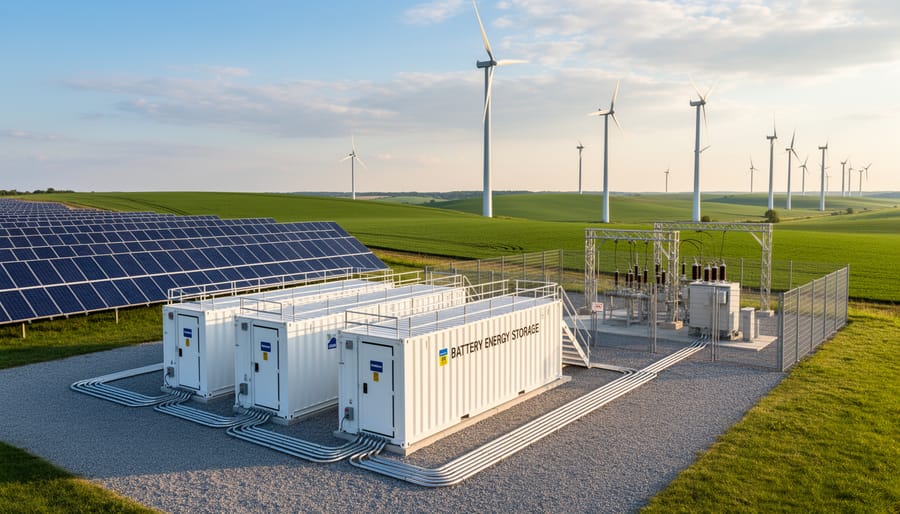
Energy storage systems operate through a continuous three-phase cycle that captures excess electricity, holds it with minimal loss, and releases it when needed. During the charge phase, renewable sources like solar panels or wind turbines generate electricity that exceeds immediate demand. This surplus energy flows into the storage system, where it undergoes conversion from electrical form into another energy state, chemical potential in batteries, gravitational potential in pumped hydro, kinetic energy in flywheels, or thermal energy in molten salt systems. The specific conversion mechanism depends on the storage technology, but all follow the same principle: transforming electrical energy into a storable form.
The storage phase maintains captured energy until required. Modern systems achieve this with remarkably low self-discharge rates, lithium-ion batteries typically lose only 1-5% of stored energy per month, while pumped hydro can hold energy for weeks with negligible losses. The storage medium’s characteristics determine duration capabilities: batteries excel at short to medium-term storage (hours to days), while mechanical systems like pumped hydro handle longer durations efficiently. Temperature management, containment integrity, and material stability all influence how effectively a system retains energy during this holding period.
When demand rises or renewable generation drops, the discharge phase reverses the conversion process. Stored energy transforms back into electricity through inverters and power electronics that ensure the output matches grid requirements. These sophisticated devices convert direct current (DC) from batteries or variable-frequency AC from generators into stable, grid-compatible alternating current at precisely 50 or 60 Hz. They also regulate voltage, manage power quality, and respond to grid signals within milliseconds.
Grid integration requires bidirectional communication between storage systems and grid operators. Advanced control systems monitor grid frequency, voltage fluctuations, and demand patterns in real time. When frequency drops below standard (indicating insufficient generation), storage systems automatically inject power. When frequency climbs (signaling excess generation), they absorb energy. This dynamic balancing happens continuously, with utility-scale batteries responding in under one second compared to traditional fossil fuel plants that need minutes to ramp up.
Round-trip efficiency measures how much input energy returns as usable output. Lithium-ion batteries achieve 85-95% efficiency, meaning only 5-15% is lost to heat and conversion processes. Pumped hydro reaches 70-85%, while compressed air systems range from 40-70% depending on configuration. These efficiency figures directly impact economic viability and environmental benefits, as higher efficiency means less renewable generation capacity needed to meet storage requirements.
Major Types of Renewable Energy Storage Technologies
Battery Energy Storage Systems
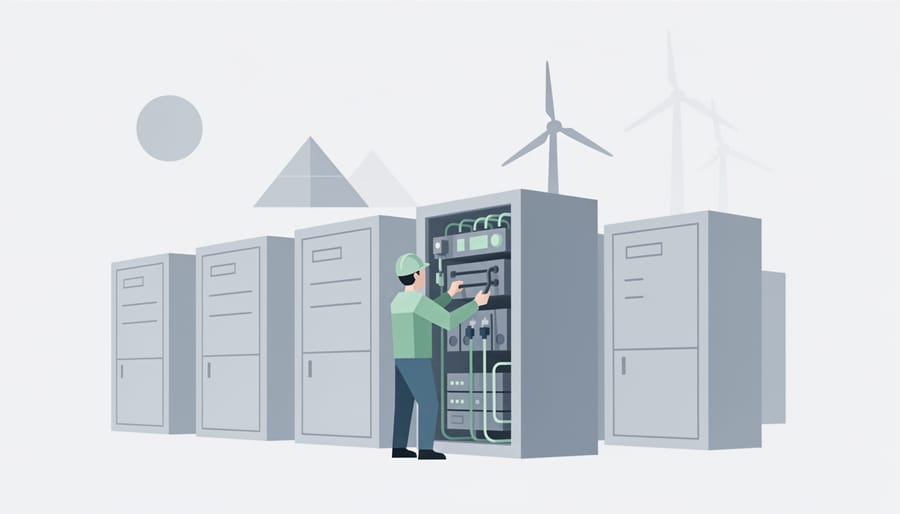
Battery energy storage systems convert electrical energy into chemical energy through electrochemical reactions, storing it within cells that can later release that energy on demand. When charging, electrical current drives ions between electrodes through an electrolyte medium, creating a chemical potential difference. During discharge, the reaction reverses, generating electricity as ions flow back across the circuit.
The dominant battery technologies in renewable energy storage each offer distinct advantages:
- Lithium-ion batteries deliver high energy density and represent the most mature technology, dominating installations from residential systems to grid-scale projects
- Flow batteries store energy in liquid electrolytes held in external tanks, enabling long-duration discharge and independent scaling of power and capacity
- Sodium-ion batteries use abundant materials rather than scarce lithium and cobalt, positioning them as an emerging cost-effective alternative for stationary storage
- Solid-state batteries replace liquid electrolytes with solid materials, offering next-generation safety advantages and higher energy density, though commercial deployment remains limited in 2026
Battery storage scales remarkably well across applications. Residential systems typically range from 5 to 20 kilowatt-hours, providing backup power and solar energy time-shifting for individual homes. Commercial installations serve buildings with hundreds of kilowatt-hours, managing demand charges and grid services. Utility-scale battery parks now exceed 1,000 megawatt-hours in single installations, storing enough energy to power tens of thousands of homes for hours.
Deployment accelerated sharply through the mid-2020s. Lithium-ion installations continue expanding across all scales, while flow batteries gain traction for four-hour-plus duration applications where their degradation resistance justifies higher upfront costs. Sodium-ion technology moved from pilot projects to commercial manufacturing, particularly in markets prioritizing supply chain resilience. The technology you’ll encounter depends on project requirements, duration needed, space constraints, budget, and performance priorities all influence which chemistry makes sense for a given renewable energy application.
Mechanical Storage Solutions
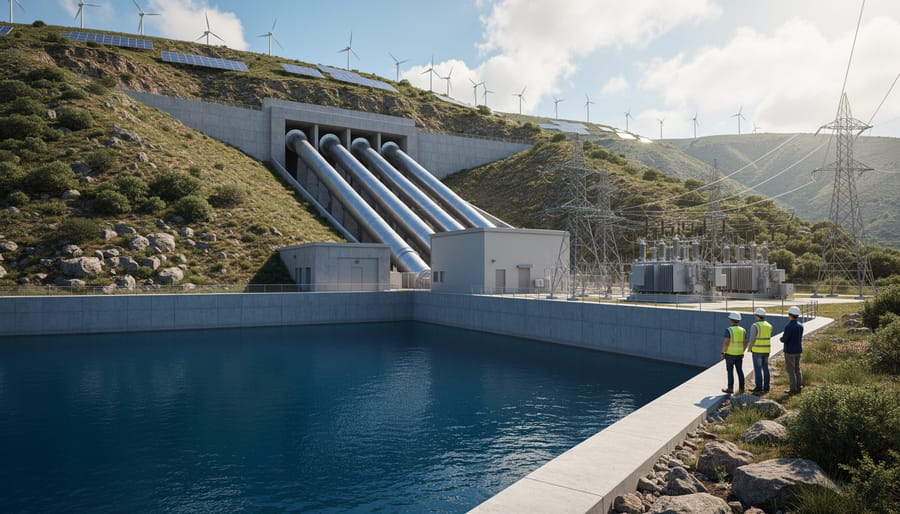
Mechanical storage solutions rank among the oldest and most proven electricity storage technologies converting electrical energy into physical forms, gravitational potential, kinetic motion, or pressurized air, that can be reconverted to electricity when needed. These systems excel at large-scale, long-duration storage, making them particularly valuable for grid applications requiring hours or days of discharge capacity.
Pumped hydro remains the dominant mechanical storage technology worldwide, accounting for over 90% of global grid-scale storage capacity. These systems pump water uphill to an elevated reservoir during periods of excess renewable generation, then release it through turbines to generate electricity during demand peaks. Modern pumped hydro facilities can store gigawatt-hours of energy with round-trip efficiencies of 70-85%, though they require specific geographic features including substantial elevation differences and adequate water resources.
Compressed air energy storage (CAES) operates on a similar principle but uses underground caverns, often repurposed salt domes or depleted natural gas reservoirs, to store energy as high-pressure air. During charging, excess electricity drives compressors that pump air into these geological formations. When electricity is needed, the compressed air is released, heated, and expanded through turbines to generate power. While CAES installations remain relatively rare in 2026, the technology offers multi-hour discharge durations without geographical constraints as strict as pumped hydro.
Flywheel systems store energy as rotational kinetic energy in a rapidly spinning rotor, typically suspended by magnetic bearings in a vacuum chamber to minimize friction losses. These systems respond within milliseconds, making them ideal for frequency regulation and power quality applications rather than long-duration storage. Their cycle life extends into millions of charge-discharge cycles, though energy capacity remains limited compared to pumped hydro or CAES.
Thermal Energy Storage
Thermal energy storage systems work by capturing heat or cold for deployment hours or even days later, making them particularly valuable in renewable energy contexts where timing of generation and demand rarely align. Unlike batteries that store energy electrochemically, these systems store it as temperature differential in physical materials.
Molten salt thermal storage has become the dominant solution for concentrated solar power plants, where sunlight heats salt mixtures to temperatures exceeding 565°C (1,050°F). The liquid salt flows into insulated tanks, retaining heat with minimal loss for 10-14 hours. When electricity is needed after sunset, the hot salt generates steam to drive turbines, effectively extending solar generation into evening peak demand periods without requiring batteries.
Ice storage serves the opposite function in commercial buildings, using off-peak electricity to freeze water during night hours when renewable generation often exceeds demand. The ice then provides cooling during daytime, reducing air conditioning loads precisely when grids face their greatest stress. This approach is common in hospitals, universities, and large office complexes seeking to lower demand charges while supporting grid stability.
Other thermal storage methods include underground seasonal storage using soil or rock masses, phase-change materials that absorb heat during melting, and thermochemical systems that store energy in reversible chemical reactions. These technologies remain relatively niche but offer duration capabilities, days to months, that electrochemical systems cannot economically match for heating and cooling applications in renewable energy systems.
Emerging Storage Technologies
Beyond these established technologies, several innovative energy storage approaches show promise for addressing specific renewable energy challenges, though most remain in pilot or early commercial stages.
Hydrogen storage converts surplus renewable electricity into hydrogen gas through electrolysis, which can be stored and later used to generate electricity via fuel cells or combustion turbines. This approach offers seasonal storage potential and integration with industrial applications, but currently faces challenges with round-trip efficiency (typically 30-40%), high infrastructure costs, and energy-intensive conversion processes. Green hydrogen production is expanding, with projects primarily focused on industrial decarbonization rather than electricity storage.
Gravity-based systems use excess renewable energy to lift heavy masses, concrete blocks or weighted pistons, then generate electricity as these masses descend. Companies are testing these concepts at demonstration scale, attracted by the use of abundant materials and potentially long operational lifespans. However, these systems require significant physical infrastructure and remain unproven at commercial scale.
Other emerging technologies include liquid air energy storage (which cools air to cryogenic temperatures for storage), iron-air batteries offering multi-day duration at lower costs, and advanced compressed CO2 storage systems. While these innovations address genuine gaps in the storage landscape, particularly long-duration needs exceeding battery capabilities, most face years of development before reaching cost-competitiveness and reliability standards for widespread renewable energy deployment.
Applications and Uses in Renewable Energy Systems
Grid-Scale Energy Storage
Grid-scale energy storage systems serve as the backbone infrastructure that allows electrical networks to integrate substantial amounts of wind and solar generation. These installations, typically ranging from tens to hundreds of megawatts, absorb excess renewable electricity during periods of high production and release it when generation drops or demand peaks. This charge-discharge capability directly addresses the fundamental mismatch between when renewable sources produce power and when consumers need it.
Beyond simple energy shifting, grid-scale storage provides critical ancillary services that maintain power quality and system reliability. Storage facilities respond to frequency deviations within milliseconds, injecting or absorbing power to keep the grid at its required 50 or 60 Hz operating frequency. This rapid response capability, far quicker than conventional gas turbines can achieve, becomes increasingly valuable as grids transition away from the inherent inertia provided by spinning generators at fossil fuel plants.
Utility-scale battery systems, pumped hydro facilities, and compressed air installations also enable grid operators to defer costly transmission upgrades. By strategically locating storage where congestion occurs, utilities can store locally generated renewable power rather than curtailing it, effectively increasing the hosting capacity of existing infrastructure. This economic benefit, combined with wholesale market arbitrage opportunities and capacity value, has driven substantial deployment growth across regions with ambitious renewable energy targets.
Distributed and Behind-the-Meter Storage
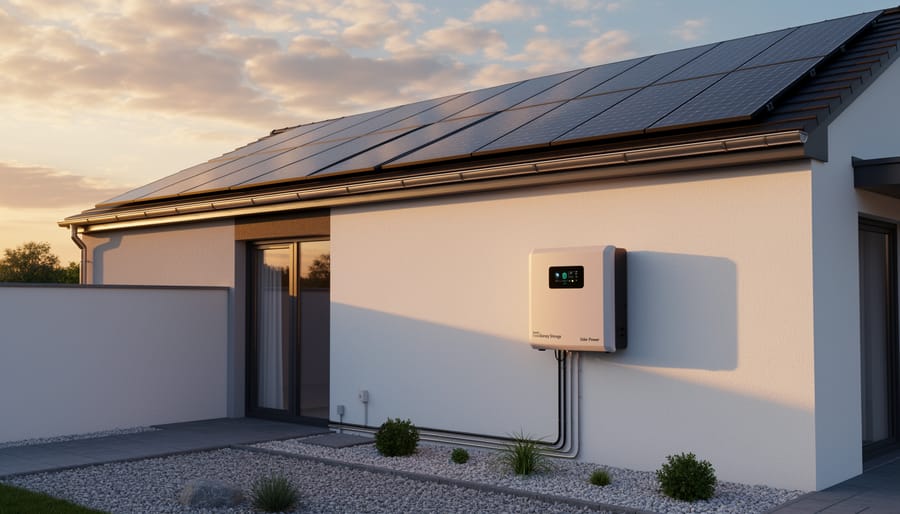
Behind-the-meter storage refers to systems installed on the customer side of the utility meter, serving individual buildings or facilities rather than the grid at large. These installations have grown rapidly as battery costs have declined and solar adoption has increased.
Residential solar-plus-storage systems combine rooftop panels with battery units, typically ranging from 10-20 kWh capacity. Homeowners store excess daytime solar generation for evening use, reducing reliance on grid electricity and lowering bills. During outages, batteries provide backup power for critical loads like refrigeration, medical equipment, and communications. Some systems participate in virtual power plant programs, aggregating distributed batteries to support grid services while compensating owners.
Commercial and industrial facilities deploy larger systems, often 50 kWh to several MWh, primarily for demand charge management. By discharging batteries during peak usage periods, businesses avoid the expensive demand charges utilities impose based on maximum power draw. A manufacturing plant might use stored energy during production peaks, cutting monthly electricity costs by 20-30%. These installations also provide resilience for operations where downtime carries significant financial consequences.
Multi-tenant buildings increasingly integrate shared storage systems, distributing benefits across residents while optimizing building-wide energy costs and providing collective backup capability.
Off-Grid and Microgrid Applications
Energy storage serves as the backbone of off-grid renewable energy systems, making electricity access viable in locations where grid extension is impractical or prohibitively expensive. In remote communities, from Arctic research stations to island nations, battery systems paired with solar panels or small wind turbines provide reliable power that was previously dependent on costly diesel generators. These systems store excess generation during peak production hours, ensuring continuous electricity supply through nights and low-wind periods.
Microgrids for villages, industrial sites, and disaster-prone regions rely on storage to balance variable renewable output with consistent demand. A well-designed microgrid combines generation, storage, and intelligent controls to operate independently or connect opportunistically to larger grids. Storage capacity typically ranges from several hours to multiple days, depending on renewable resource patterns and backup requirements. Island communities in the Caribbean and Pacific have demonstrated that appropriately sized battery storage can reduce diesel consumption by 80% or more while improving power reliability and lowering long-term energy costs for residents who previously faced some of the world’s highest electricity rates.
Benefits and Challenges
Energy storage technology delivers substantial benefits that make renewable energy systems viable at scale. Storage enables grid operators to smooth out the inherent variability of solar and wind generation, storing excess power during peak production hours and releasing it when generation drops. This capability directly addresses the intermittency challenge that has historically limited renewable energy penetration on electrical grids. Storage systems also provide critical grid services including frequency regulation, voltage support, and black-start capability, functions traditionally supplied by fossil fuel power plants. For consumers, storage means greater energy independence, lower electricity costs through time-of-use arbitrage, and reliable backup power during outages.
Economic benefits extend beyond individual users. Energy storage innovations allow utilities to defer expensive transmission and distribution infrastructure upgrades by managing local demand peaks. Storage reduces curtailment of renewable generation, ensuring that clean energy produced gets used rather than wasted. The technology also creates new revenue opportunities through ancillary services markets and capacity mechanisms that compensate storage operators for grid support functions.
Despite these advantages, significant challenges remain. Upfront capital costs for storage systems, particularly at grid scale, represent a major barrier to deployment. While battery prices have dropped substantially over the past decade, lithium-ion storage still requires considerable investment relative to the energy capacity delivered. Technology limitations constrain certain applications: most battery systems offer duration of four hours or less, insufficient for seasonal storage or multi-day backup needs.
Resource constraints pose sustainability concerns. Lithium, cobalt, and other materials critical to battery production face supply chain vulnerabilities and environmental extraction impacts. The recycling infrastructure for end-of-life batteries remains underdeveloped in most regions, creating potential waste challenges as early storage installations reach retirement.
Regulatory frameworks have not kept pace with storage deployment. Many electricity markets lack clear rules for how storage systems can participate or be compensated for the multiple services they provide. Permitting processes vary widely across jurisdictions, creating uncertainty for developers. Safety standards and fire codes continue evolving as regulators gain experience with large-scale battery installations, occasionally delaying projects while new requirements take shape.
Frequently Asked Questions
Energy storage systems raise practical questions for anyone considering renewable energy adoption or seeking to understand the technology’s real-world implications. The following addresses the most common concerns about performance, costs, environmental impacts, and operational characteristics.
How long can energy storage systems hold their charge?
Storage duration varies dramatically by technology: batteries typically discharge over hours to days, pumped hydro can store energy for weeks or months with minimal loss, and thermal storage systems maintain heat or cold for days. Self-discharge rates range from under 1% per day for pumped hydro to 5-20% monthly for some battery chemistries.
What do energy storage systems cost?
Costs span a wide range depending on technology and scale. Lithium-ion battery systems currently range from $300 to $600 per kilowatt-hour for utility-scale installations, while residential systems cost more per kWh due to smaller scale and additional components. Pumped hydro has higher upfront capital costs but lower per-kWh storage costs for large-scale, long-duration applications.
What is the environmental impact of energy storage?
Environmental footprints vary by technology: lithium-ion batteries require mining of materials like lithium and cobalt, raising concerns about extraction impacts and end-of-life recycling; pumped hydro needs suitable geography and can affect local ecosystems; flow batteries use less problematic materials but require larger footprints. Most technologies deliver net environmental benefits when enabling renewable energy displacement of fossil fuels.
How efficient are energy storage systems?
Round-trip efficiency, the percentage of input energy retrievable after storage, ranges from 75-90% for lithium-ion batteries, 70-85% for pumped hydro, 40-70% for compressed air systems, and 30-40% for hydrogen storage via electrolysis and fuel cells. These losses represent the trade-off for time-shifting renewable energy to when it’s needed.
Lifespan is another critical consideration. Battery systems typically provide 3,000 to 10,000 full charge-discharge cycles before capacity degrades significantly, translating to 10-20 years depending on usage patterns and chemistry. Mechanical systems like pumped hydro can operate for 50-100 years with proper maintenance, while flywheels and thermal storage fall in the 15-30 year range. The economics of storage depend heavily on these operational lifetimes, which determine how many years a system can deliver value before requiring replacement or major refurbishment.
Energy storage technology stands as an indispensable pillar of the renewable energy revolution, transforming intermittent solar and wind resources into reliable, dispatchable power sources. Without effective storage solutions, the transition to a carbon-neutral grid would remain fundamentally constrained by the mismatch between when renewable energy is generated and when electricity is needed.
The diversity of storage technologies now available, from established lithium-ion batteries and pumped hydroelectric systems to emerging hydrogen and gravity-based solutions, demonstrates both the maturity of the field and its continued evolution. This variety allows developers to match storage solutions to specific contexts, whether providing milliseconds of grid stabilization or days of backup power during extended weather events.
Looking forward, the trajectory for energy storage remains decidedly positive. Costs continue declining, deployment accelerates globally, and innovation flourishes across multiple technology pathways. Battery energy densities improve, mechanical storage systems scale up, and thermal storage integrates more seamlessly with industrial processes. Policy frameworks increasingly recognize storage’s value, enabling new market participation and revenue streams.
Challenges persist, particularly around critical mineral supply chains, recycling infrastructure, and long-duration storage economics, but these represent engineering and policy problems with identified solutions rather than fundamental barriers. The storage industry is addressing these concerns through materials research, circular economy initiatives, and diverse technology development.
As storage technologies mature and proliferate, they increasingly enable what was once theoretical: an electrical grid powered predominantly by renewable sources, where stored energy fills the gaps between generation and consumption, supporting both energy security and climate goals simultaneously.