

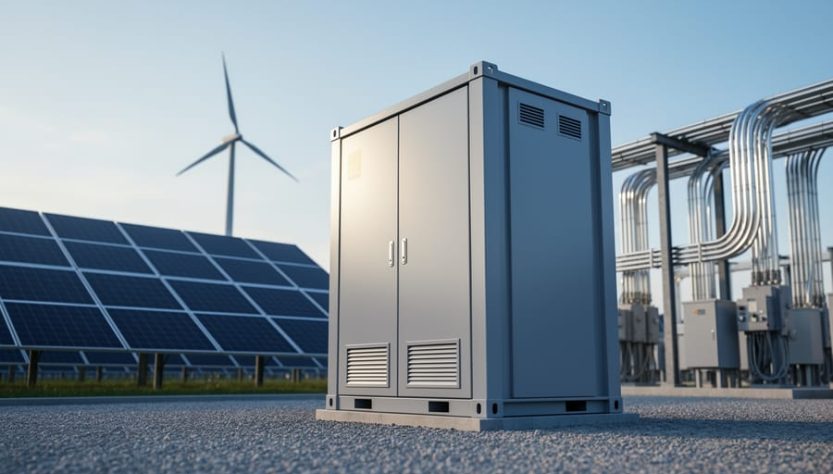
Renewable energy storage technology encompasses the systems and methods used to capture energy produced from renewable sources like solar and wind, store it, and release it when needed. These technologies bridge the gap between intermittent energy generation and consistent power demand, transforming renewable sources from supplemental options into reliable baseload providers.
The challenge is straightforward: solar panels generate electricity only when the sun shines, and wind turbines spin only when air moves. Without storage, excess energy generated during peak production hours goes to waste, while periods of low generation require backup from fossil fuel plants. Storage systems solve this mismatch by absorbing surplus energy and dispatching it during high-demand periods or when renewable generation drops. This capability has become essential as renewables now comprise a growing share of global electricity generation, with many grids facing stability challenges without adequate storage capacity.
Storage technology matters because it determines how quickly societies can transition away from carbon-intensive energy. Grid operators need storage to maintain frequency stability and prevent blackouts. Utilities use it to defer costly infrastructure upgrades. Businesses deploy storage to reduce peak demand charges and increase energy independence. As of 2026, the storage market encompasses technologies ranging from lithium-ion batteries that respond in milliseconds to pumped hydroelectric systems that can discharge for hours.
This article explains how renewable energy storage functions at a technical level, categorizes the major storage technologies by mechanism and application, and examines real-world deployments across residential, commercial, and utility-scale projects. You’ll gain clarity on which storage approaches suit different energy profiles and why certain technologies dominate specific market segments. The goal is practical knowledge that informs decisions about integrating storage into energy systems.
What Renewable Energy Storage Technology Means
Renewable energy storage technology refers to any system or method that captures electrical energy produced by renewable sources, primarily solar panels and wind turbines, and holds it for use at a later time. Instead of letting surplus energy go to waste when the sun is shining brightly or the wind is blowing strongly, storage systems bank that energy so it can be dispatched when demand is high or when renewable generation drops off.
The fundamental problem storage solves is intermittency. Solar arrays generate power only during daylight hours, with output peaking at midday. Wind turbines produce electricity whenever sufficient wind is available, which varies by location and weather patterns. These natural fluctuations don’t align with how people actually use electricity throughout the day. Storage systems create a buffer, capturing excess generation during peak production periods and releasing it during evening demand surges or overnight hours when solar generation ceases.
At its core, the technology works through a cycle of charging and discharging. When renewable generation exceeds immediate demand, the storage system absorbs the surplus and converts it into a storable form, chemical energy in batteries, potential energy in pumped water, compressed air, or thermal energy in heated materials. When the grid needs power, the system reverses the process, converting stored energy back into electricity and injecting it into the grid at precisely the right moment.
- Energy Storage Capacity
- The total amount of energy a system can hold, typically measured in kilowatt-hours (kWh) or megawatt-hours (MWh). This determines how much energy can be stored during surplus periods.
- Round-Trip Efficiency
- The percentage of energy that can be retrieved from storage compared to the amount originally put in. Higher efficiency means less energy is lost during the charge-discharge cycle.
- Discharge Duration
- How long a storage system can deliver its rated power output, ranging from minutes to several hours or days. Duration determines whether a system suits short-term grid balancing or multi-day backup.
- Grid-Scale Storage
- Large storage installations designed to serve utility networks, typically rated in megawatts or gigawatts. These systems stabilize entire regions rather than individual buildings.
This ability to decouple renewable energy generation from consumption transforms intermittent sources into dispatchable resources that grid operators can rely on. Storage makes renewable energy practical for baseload power, not just supplemental generation.
How Renewable Energy Storage Systems Work
The Energy Capture and Conversion Phase
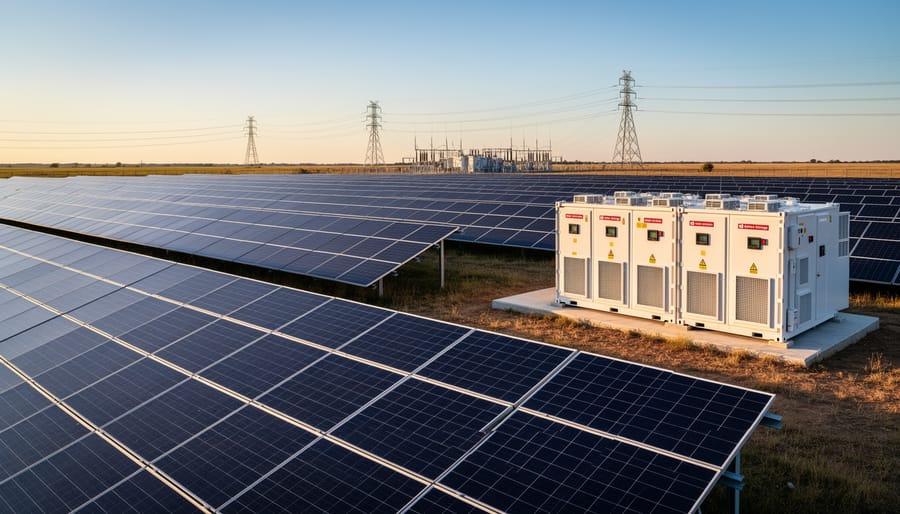
When renewable sources like solar panels or how wind power works generate more electricity than the grid needs, that surplus energy must be converted into a form suitable for storage. This conversion begins at the point where generation meets the storage system, typically through power electronics that manage voltage and current flow.
Solar arrays and wind turbines produce varying forms of electricity, solar panels generate direct current (DC), while wind turbines usually produce alternating current (AC). Inverters and rectifiers perform the essential task of matching this incoming energy to the storage medium’s requirements. If batteries are the destination, AC must be converted to DC at the precise voltage the battery chemistry demands. The conversion equipment regulates power quality, filtering out voltage spikes and harmonics that could damage storage components.
During this phase, control systems monitor generation output in real time, automatically routing excess energy into storage rather than curtailing it. These systems balance efficiency against speed, ensuring minimal energy loss during conversion while responding quickly to grid conditions.
Storage and Grid Integration
Once energy is stored, the system must maintain that energy in a stable, ready-to-use state while continuously communicating with grid operators to determine when discharge will deliver maximum value. Modern storage installations connect to advanced energy management systems that monitor grid frequency, voltage levels, and load forecasts in real time. When demand spikes or renewable generation drops, the grid operator signals the storage system to discharge, injecting power within milliseconds to seconds depending on the technology.
This two-way communication relies on protocols like Modbus, DNP3, or proprietary interfaces that transmit dispatch commands and operational data between the storage facility and grid control centers. Sophisticated software algorithms analyze price signals, demand patterns, and weather forecasts to optimize charge-discharge schedules, ensuring the system charges during low-cost or high-generation periods and discharges when energy is most needed or valuable. Battery management systems continuously balance cells, regulate temperature, and prevent overcharge or deep discharge to preserve capacity and extend operational life.
The result is a responsive resource that grid operators can deploy like a conventional power plant, but with faster ramp rates and bidirectional capability that supports both energy delivery and grid stabilization services.
Major Categories of Storage Technology
Battery Storage Systems
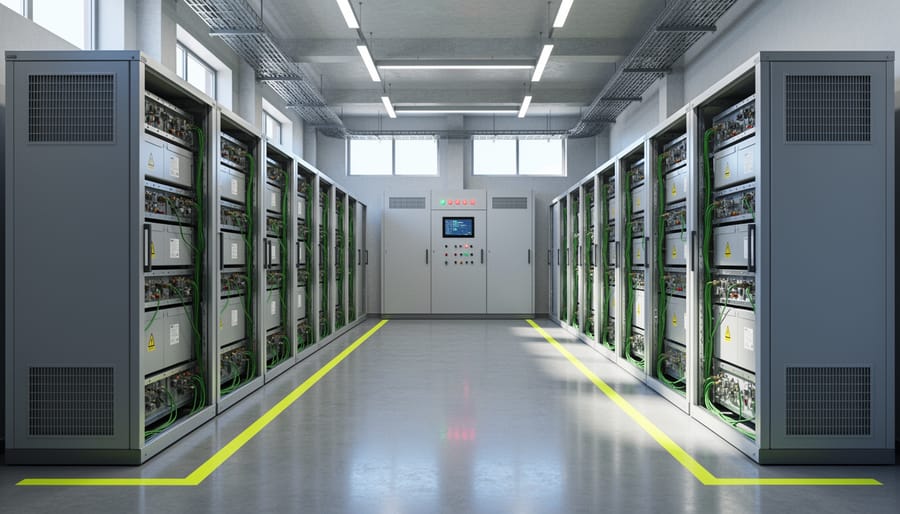
Battery storage systems rely on electrochemical reactions to store and release energy, making them the most widely deployed storage technology for renewable applications in 2026. These systems convert electrical energy into chemical potential during charging and reverse the process during discharge, offering flexible, modular solutions that scale from residential installations to utility-scale arrays.
Lithium-ion batteries dominate the market due to their high energy density, efficiency rates exceeding 90 percent, and rapidly declining costs, prices have dropped approximately 80 percent over the past decade. These batteries power grid-scale storage projects, commercial backup systems, and residential solar installations. Their relatively compact footprint and proven performance make them the default choice for applications requiring frequent cycling and fast response times.
Flow batteries present an alternative architecture particularly suited to long-duration storage needs. Unlike conventional batteries that store energy in solid electrodes, flow batteries circulate liquid electrolytes through electrochemical cells. This design decouples power capacity from energy capacity, allowing operators to scale storage duration independently by simply increasing electrolyte tank size. Vanadium redox and zinc-bromine chemistries offer cycle lives exceeding 10,000 cycles with minimal degradation, making them economically attractive for applications requiring daily discharge over multi-hour periods.
Solid-state battery innovations represent the emerging frontier, replacing liquid electrolytes with solid materials that promise higher energy densities, improved safety profiles, and extended temperature ranges. Early commercial deployments in 2026 demonstrate energy densities 50 to 70 percent higher than conventional lithium-ion designs, though manufacturing costs remain elevated. These advances address critical limitations around thermal management and fire risk while enabling more compact system designs that reduce installation costs and space requirements.
Mechanical Storage Solutions
Mechanical storage systems convert electrical energy into physical forms such as gravitational potential, compressed air, or kinetic rotation. These technologies often achieve long discharge durations and high power output, making them valuable for grid-scale applications where multi-hour energy delivery is required.
Pumped hydro storage remains the most established mechanical option globally. During periods of surplus electricity, water is pumped from a lower reservoir to an elevated basin. When demand rises, the stored water flows downhill through turbines to generate electricity. These facilities can provide hundreds of megawatts for several hours, though they require specific geographic features, suitable elevation differences and water availability, which limits deployment locations.
Compressed air energy storage (CAES) captures excess electricity by compressing air into underground caverns, depleted natural gas fields, or purpose-built pressure vessels. When energy is needed, the compressed air is heated and expanded through turbines to produce power. Modern adiabatic CAES designs capture and store the heat generated during compression, improving round-trip efficiency compared to earlier diabatic systems that require natural gas combustion.
Flywheel systems store energy by accelerating a rotor to high speeds within a low-friction housing. They excel at rapid charge-discharge cycles and provide short bursts of power, typically for seconds to minutes. This makes flywheels ideal for frequency regulation and grid stabilization rather than extended energy delivery.
Thermal and Chemical Storage
Thermal and chemical storage systems operate on fundamentally different principles than batteries, converting electrical energy into heat or chemical bonds for later retrieval. Molten salt storage, used predominantly with concentrating solar power plants, heats mixtures of sodium and potassium nitrate to temperatures exceeding 500°C. These salts retain thermal energy for hours or days, then generate steam to drive turbines when electricity is needed. Hot water systems work similarly but at lower temperatures, storing excess renewable energy in insulated tanks for district heating or industrial processes. Hydrogen storage represents a chemical pathway, using electrolyzers to split water molecules with surplus renewable electricity, producing hydrogen gas that can be compressed, liquefied, or stored in chemical carriers. When energy demand rises, fuel cells or combustion systems convert hydrogen back to electricity or direct heat, offering multi-day or seasonal storage capacity that batteries cannot match economically at scale.
How Renewable Energy Storage Is Applied Today
Grid-Scale Stabilization
Utilities install large-scale storage arrays, often hundreds of megawatts in capacity, to maintain grid stability as renewable generation displaces conventional power plants. These systems rapidly inject or absorb electricity, correcting frequency deviations within milliseconds, a critical function previously handled by spinning turbines in coal and gas plants. When wind or solar output surges beyond demand, the storage array charges, preventing curtailment and capturing value from otherwise wasted energy. During evening peaks or calm periods, the stored energy discharges, meeting load without firing up fossil generators.
Beyond simple time-shifting, grid-scale storage provides ancillary services that keep the grid reliable. Frequency regulation, voltage support, and synthetic inertia all stabilize the system against sudden changes. Storage can also defer costly transmission and distribution upgrades by relieving congestion at key nodes. In regions with high renewable penetration, multiple storage projects work in concert with grid operators, who dispatch them based on real-time pricing signals and system needs.
Recent energy storage innovations have improved response times and reduced degradation, making these large arrays economically viable for daily cycling. Utilities now rely on storage to integrate variable renewables at scale, transforming what was once an intermittency problem into a manageable, flexible resource that enhances overall grid resilience.
Distributed and Behind-the-Meter Storage
Commercial buildings and residential homeowners increasingly deploy storage systems on their side of the utility meter to capture direct economic and operational benefits. These behind-the-meter installations pair with rooftop solar arrays to maximize self-consumption, storing excess daytime generation and discharging it during evening peak hours when grid electricity costs more. This load-shifting cuts utility bills substantially, especially in markets with time-of-use rates.
For commercial facilities facing demand charges, fees based on peak power draw within a billing period, battery systems shave these peaks by supplying stored energy during high-consumption moments. A warehouse running refrigeration equipment can avoid costly spikes when multiple compressors start simultaneously. The financial returns often justify installation costs within several years.
Backup power represents another primary driver, particularly in regions with unreliable grids or frequent extreme weather events. Unlike generators requiring fuel and maintenance, battery systems activate instantly during outages, keeping critical loads operational. Residential systems typically support essential circuits for 8-12 hours, while larger commercial installations can sustain operations for days when paired with adequate solar capacity.
This distributed storage model reduces transmission losses, defers grid infrastructure upgrades, and gives property owners energy independence alongside resilience.
Current Innovations Advancing Battery Storage
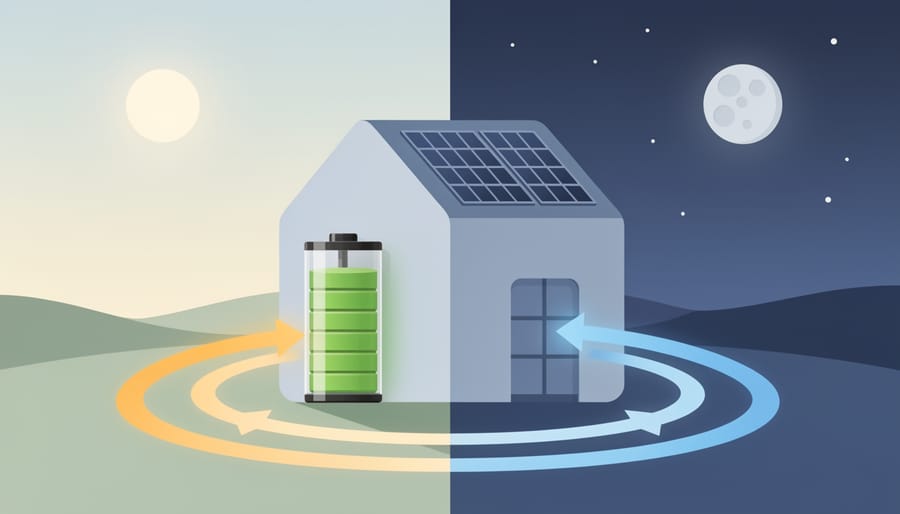
Battery storage technology is evolving rapidly as researchers and manufacturers address longstanding limitations in energy density, charging speed, safety, and cost. Several innovations now moving from laboratory testing to commercial deployment are poised to reshape how energy storage supports renewable integration.
Solid-state batteries represent one of the most promising advances. Unlike conventional lithium-ion cells that use liquid electrolytes, solid-state designs employ solid ceramic or polymer electrolytes. This structural change eliminates flammability risks associated with liquid electrolytes and enables higher energy density by allowing lithium metal anodes. Several manufacturers have announced pilot production lines for solid-state cells targeting grid storage applications, with early systems demonstrating 40-50% greater energy density than current lithium-ion equivalents. The challenge remains scaling production while managing manufacturing costs, but projections suggest commercial viability for utility-scale projects by 2027.
Silicon anode technology offers another pathway to performance gains within existing lithium-ion architectures. Traditional graphite anodes are being replaced or augmented with silicon nanostructures that can store significantly more lithium ions. Silicon anodes theoretically provide ten times the capacity of graphite, though managing the material’s expansion during charging cycles has historically caused rapid degradation. Recent breakthroughs in nanostructured silicon and protective coatings have extended cycle life beyond 1,000 full charge-discharge cycles, making these cells practical for demanding storage applications. Batteries incorporating silicon anodes are entering the market now, delivering 20-30% capacity improvements over standard cells at comparable costs.
Advanced lithium chemistries continue to diversify beyond the dominant nickel-manganese-cobalt formulations. Lithium iron phosphate batteries have gained substantial market share in stationary storage due to their thermal stability, long cycle life exceeding 6,000 cycles, and lower material costs. Lithium-sulfur and lithium-air chemistries remain in development but promise theoretical energy densities two to five times higher than current technologies, potentially transforming economics for large-scale deployments.
Software and control systems have emerged as critical innovation drivers alongside hardware improvements. Advanced battery management systems now use machine learning algorithms to optimize charging patterns, predict degradation, and coordinate with grid signals for maximum value capture. These platforms enable storage operators to participate in multiple revenue streams simultaneously, stacking services like frequency regulation, peak shaving, and energy arbitrage. The result is improved financial returns that accelerate project deployment and align with broader renewable trends driving sector transformation.
Common Questions About Energy Storage
How long do storage systems last, and can they handle extreme weather? Are batteries safe near homes and businesses? These practical concerns shape purchasing and policy decisions across the industry. The following answers draw on operational data and manufacturer specifications from systems deployed across diverse climates and applications.
How long do storage batteries last?
Lithium-ion batteries typically retain 70-80% of their original capacity after 10-15 years or 3,000-5,000 charge cycles, depending on usage patterns and environmental conditions. Flow batteries can exceed 20 years with minimal degradation because their electrolyte can be replaced independently of the system hardware.
Are energy storage systems safe?
Modern storage installations incorporate multiple safety layers including thermal management systems, automatic disconnect switches, and fire suppression equipment. Residential and commercial battery systems meet rigorous UL and IEC safety standards, with incident rates comparable to other electrical infrastructure when properly installed and maintained.
What happens to old batteries?
Retired batteries often enter second-life applications where reduced capacity remains useful for less demanding tasks, extending their total service life by 5-10 years. At end-of-life, established recycling processes recover 90-95% of materials from lithium-ion batteries, including lithium, cobalt, and nickel for new battery production.
How much does storage cost?
Utility-scale battery storage costs have fallen to $200-$300 per kilowatt-hour in 2026, down from over $1,000 per kilowatt-hour a decade ago. Residential systems range from $400-$700 per kilowatt-hour installed, with ongoing cost reductions driven by manufacturing scale and technology improvements.
Compatibility between storage systems and renewable sources depends more on system design than inherent technology limits. Solar arrays pair readily with batteries because both generate and store DC power, minimizing conversion losses. Wind turbines produce AC power that requires an additional conversion step, but modern power electronics handle this efficiently with losses under 5%. The key consideration is matching storage capacity and discharge duration to generation patterns, solar installations benefit from 4-6 hour storage to shift daytime production into evening demand peaks, while wind projects in regions with multi-day lulls may need longer-duration solutions like pumped hydro or hydrogen storage.
Environmental impact concerns extend beyond battery production to include mining practices, water use in thermal storage, and land requirements for mechanical systems. Life-cycle assessments show that storage systems paired with renewables deliver net carbon reductions within 1-3 years of operation, offsetting manufacturing emissions through avoided fossil fuel generation. Responsible sourcing programs and closed-loop recycling further reduce the footprint of new installations.
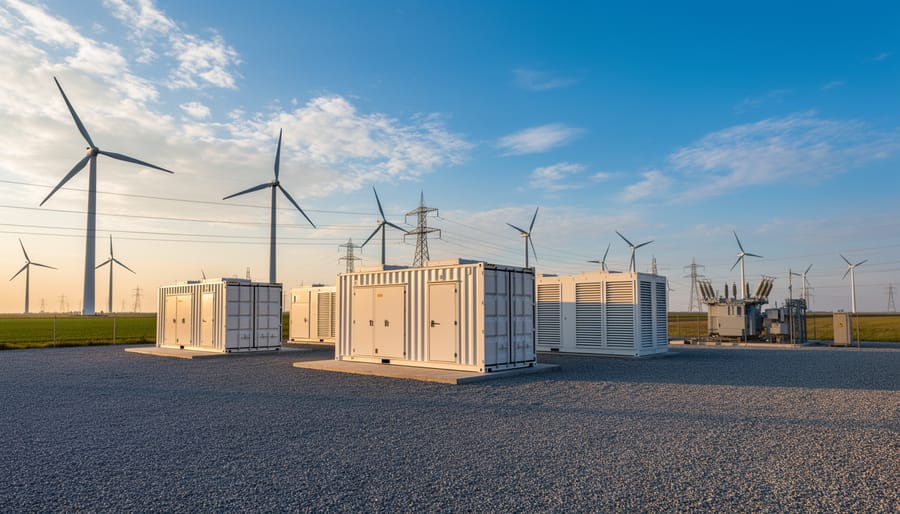
Renewable energy storage technology has emerged as the essential bridge between renewable generation and reliable, around-the-clock clean power. Without effective storage, solar and wind energy remain constrained by their inherent intermittency, producing electricity when the sun shines or wind blows rather than when demand peaks. Storage systems solve this fundamental mismatch, capturing excess energy during high production periods and releasing it precisely when needed.
The advances in battery storage over the past decade have been transformative. Costs have dropped by more than 80 percent since 2015, making utility-scale installations economically viable and accelerating deployment across continents. Innovations in lithium-ion chemistry, solid-state designs, and flow batteries continue to push the boundaries of energy density, cycle life, and safety. These improvements aren’t theoretical, they’re powering grid-scale projects that stabilize regional electricity networks and residential systems that slash energy bills while providing backup during outages.
Beyond batteries, the diversity of storage technologies strengthens the entire ecosystem. Pumped hydro provides massive capacity for seasonal balancing. Thermal storage pairs naturally with concentrated solar plants. Emerging hydrogen solutions offer pathways to decarbonize heavy industry and long-distance transport. Each technology addresses specific needs, creating a complementary portfolio rather than a single silver bullet.
As storage becomes more capable and affordable, it removes the last major technical and economic barriers to deep renewable penetration. Grid operators gain the flexibility to manage variable generation confidently. Communities in remote areas access reliable power without fossil fuel dependency. The energy transition accelerates not because of policy mandates alone, but because storage makes renewables the practical choice.