

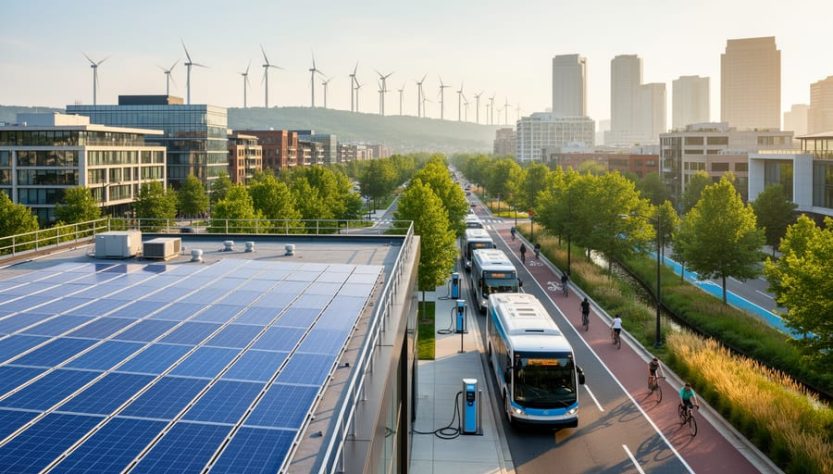
Cities worldwide are reinventing themselves through urban renewal plans that place clean energy at their core, transforming aging infrastructure into sustainable ecosystems that reduce emissions while improving quality of life. These comprehensive strategies integrate solar arrays on municipal buildings, wind turbines in peripheral zones, district heating networks powered by geothermal sources, and smart grids that optimize energy distribution across entire metropolitan areas. The urgency is clear: urban centers consume over 75 percent of global energy and produce approximately 70 percent of carbon emissions, making them both the problem and the solution in our climate crisis.
Modern urban renewal extends far beyond traditional redevelopment. It encompasses retrofitting commercial districts with energy-efficient systems, converting transportation networks to electric and hydrogen-powered fleets, and redesigning public spaces to incorporate green infrastructure that naturally regulates temperature and manages stormwater. Recent renewable energy breakthroughs have made these transformations economically viable, with declining costs for photovoltaic panels, battery storage, and wind technology enabling cities to achieve carbon neutrality targets while generating long-term savings.
The most successful plans share common elements: comprehensive stakeholder engagement, phased implementation timelines, diversified funding mechanisms combining public investment with private partnerships, and adaptive frameworks that respond to technological advances. Copenhagen’s carbon-neutral roadmap, Singapore’s integrated solar deployment, and Barcelona’s superblock initiative demonstrate how strategic planning converts environmental necessity into economic opportunity. Understanding these proven approaches equips professionals and policymakers with actionable frameworks for designing renewal plans that deliver measurable environmental, economic, and social returns while positioning cities as leaders in the global transition to clean energy.
The Evolution of Urban Renewal: From Infrastructure to Energy
Urban renewal has undergone a remarkable transformation since its inception in the mid-20th century. Initially focused on demolishing deteriorating neighborhoods and replacing them with large-scale infrastructure projects, the evolution of urban renewal reflected a highway-centric vision that often displaced communities without addressing environmental sustainability. These early initiatives prioritized transportation corridors, commercial centers, and residential developments, but paid little attention to energy efficiency or environmental impacts.
The 1970s energy crisis marked a pivotal shift in urban planning philosophy, introducing energy considerations into redevelopment discussions. Cities began exploring how building design, transportation systems, and land use patterns could reduce energy consumption. However, renewable energy remained largely peripheral to mainstream urban renewal until the late 1990s, when growing climate concerns and technological advances converged to make clean energy economically viable.
The 21st century ushered in a new paradigm where renewable energy transformed from an afterthought into a foundational element of urban renewal strategies. Solar panels, wind turbines, and geothermal systems evolved from experimental additions to essential infrastructure components. Today’s urban renewal plans integrate emerging renewable energy technologies at every planning stage, from district-level microgrids to building-integrated photovoltaics.
This evolution reflects a broader understanding that sustainable cities require comprehensive energy transformation. Contemporary urban renewal now encompasses smart grids, energy storage systems, and circular economy principles that minimize waste while maximizing renewable resource utilization. The shift has been driven by multiple factors: declining renewable technology costs, increasingly stringent climate regulations, and growing public demand for environmentally responsible development. Cities worldwide now recognize that energy transition is not merely compatible with urban renewal but essential to creating resilient, livable communities for future generations.
Core Components of Energy-Focused Urban Renewal Plans
Solar Infrastructure Integration
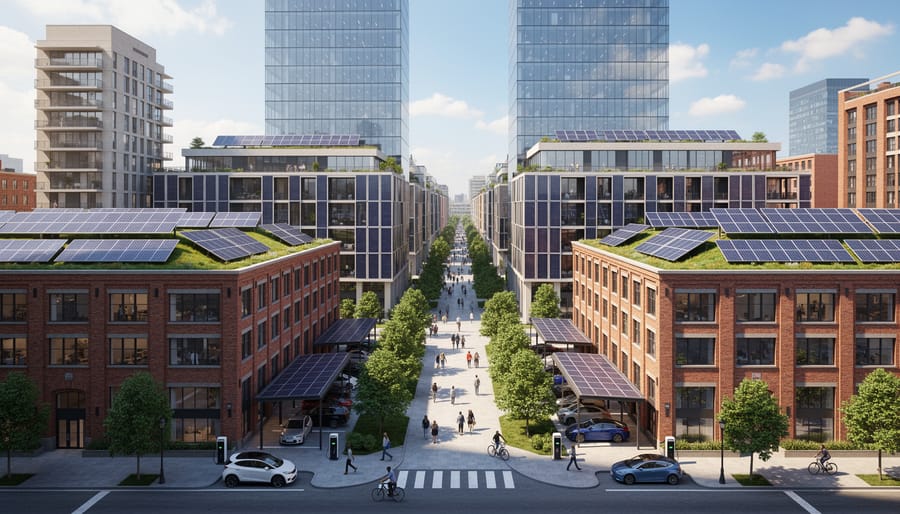
Urban renewal initiatives worldwide are increasingly embedding solar infrastructure as foundational components rather than afterthoughts. This integration manifests across three primary dimensions: building-integrated photovoltaics, ground-mounted installations, and innovative surface applications. Cities recognize that retrofitting solar technology during large-scale renewal projects proves significantly more cost-effective than subsequent installations.
Building-integrated photovoltaics represent the most visible transformation, with photovoltaic facades replacing traditional cladding on both residential and commercial structures. Copenhagen’s Nordhavn district exemplifies this approach, where over 40,000 square meters of solar facades generate electricity while maintaining architectural aesthetics. These installations typically achieve 15-20% efficiency rates while reducing cooling costs through reduced solar heat gain.
Solar roadways, though still emerging, are gaining traction in pilot programs across Europe and Asia. France’s Wattway project in Tourouvre demonstrated that photovoltaic road surfaces can withstand regular traffic while generating power, though economic viability remains under evaluation. More proven are solar canopies over parking structures and pedestrian walkways, which cities like Los Angeles have deployed extensively throughout renewal zones.
Ground-mounted solar arrays on previously contaminated brownfield sites represent particularly effective land reuse strategies. These installations transform liability properties into revenue-generating assets while remediating soil through established vegetation management practices beneath panels. Newark’s RiversEdge project converted 26 acres of industrial wasteland into a solar farm producing 13.3 megawatts, simultaneously advancing environmental cleanup and renewable energy goals. Such multifunctional approaches demonstrate how strategic solar integration addresses multiple urban challenges simultaneously.
District Energy Systems and Microgrids
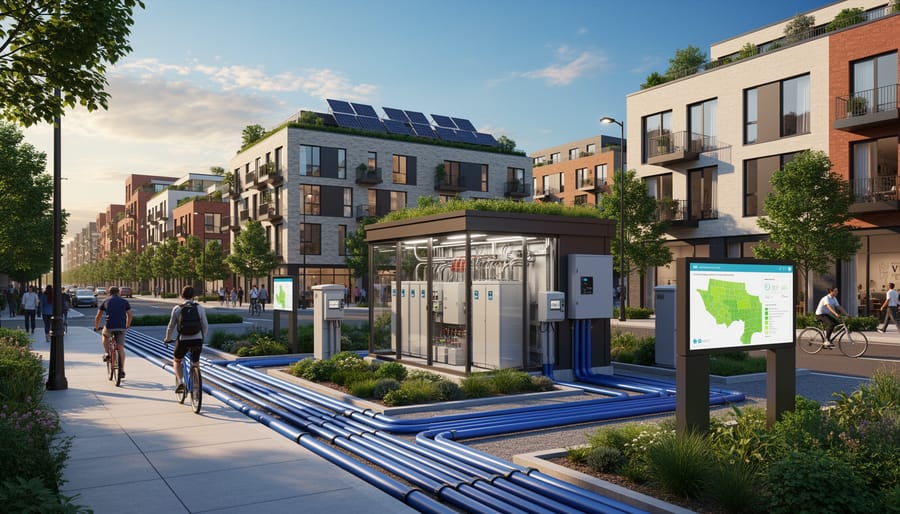
District energy systems represent a transformative approach to urban energy infrastructure, replacing centralized power plants with localized generation and distribution networks that serve entire neighborhoods or districts. These systems integrate renewable energy sources such as solar panels, wind turbines, and geothermal installations with energy storage innovations to create resilient, efficient energy ecosystems within renewed urban areas.
- Microgrids
- Self-contained electrical networks that can operate independently from the main grid, providing enhanced reliability and integrating multiple renewable energy sources with local loads.
- District Heating/Cooling
- Centralized systems that distribute thermal energy through insulated pipes to multiple buildings for space heating, water heating, or air conditioning, significantly reducing individual building energy demands.
- Distributed Energy Resources
- Small-scale power generation or storage technologies located close to where electricity is used, including rooftop solar, battery systems, and combined heat and power units.
Modern urban renewal projects increasingly incorporate these technologies to reduce transmission losses, enhance grid stability, and maximize renewable energy utilization. Copenhagen’s district heating system exemplifies this approach, serving 98 percent of the city with waste heat recovery and biomass, while Brooklyn’s microgrid project demonstrates how localized networks can maintain power during broader grid failures. These systems enable dynamic energy management, allowing districts to balance generation and consumption in real-time while providing emergency backup capabilities that traditional infrastructure cannot match.
Green Building Retrofits and Standards
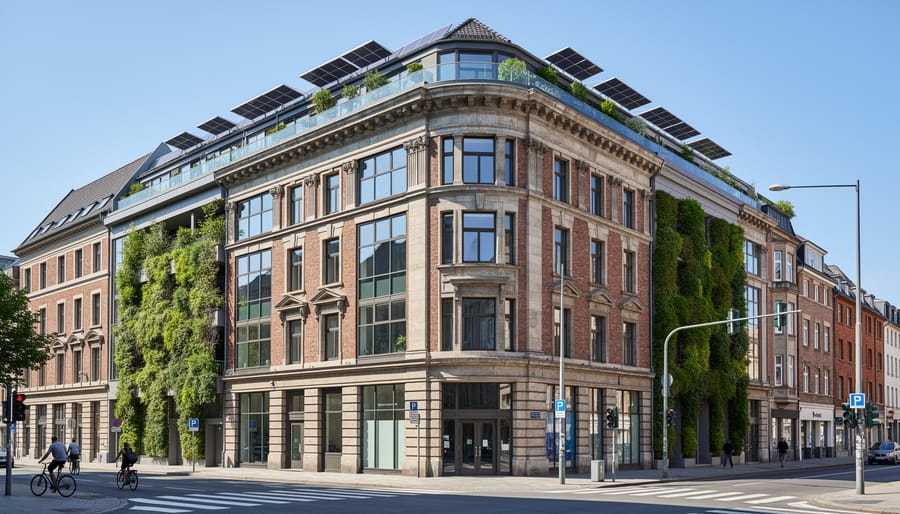
Green building retrofits represent a cornerstone of modern urban renewal efforts, transforming aging infrastructure into energy-efficient assets that reduce carbon emissions while improving occupant comfort and operational costs. These initiatives typically focus on upgrading building envelopes, installing high-performance windows, enhancing insulation, and integrating smart building management systems that optimize energy consumption in real-time.
The framework for these improvements is guided by green building standards and certification systems such as LEED (Leadership in Energy and Environmental Design), BREEAM, and the Living Building Challenge. These frameworks provide measurable benchmarks for energy performance, water efficiency, indoor environmental quality, and material sustainability. Cities implementing renewal plans increasingly mandate certification levels for both new construction and retrofit projects, creating standardized pathways toward comprehensive sustainability goals.
Retrofit projects in practice demonstrate substantial benefits. The Empire State Building’s deep energy retrofit, completed in 2011, reduced energy consumption by 38 percent through targeted improvements to windows, lighting, and HVAC systems—all while maintaining full occupancy throughout construction. Similarly, Vancouver’s commitment to requiring all buildings constructed from 2030 onward to be emissions-free has accelerated retrofit activity across its existing building stock, with property owners proactively upgrading systems to meet future requirements.
Financial incentives further accelerate adoption. Many municipalities offer tax abatements, low-interest loans, or expedited permitting for projects achieving specific certification levels. These programs recognize that building operations account for approximately 40 percent of urban energy consumption, making retrofits essential for achieving climate action targets. The combination of regulatory requirements, financial support, and proven performance metrics positions green building retrofits as practical, scalable solutions within comprehensive urban renewal strategies.
Global Case Studies: Cities Leading the Renewable Renewal Movement
Cities across the globe are demonstrating that comprehensive urban renewal centered on renewable energy is not merely aspirational but entirely achievable. These pioneering municipalities have transformed aging infrastructure into models of sustainable development, offering valuable blueprints for other urban centers embarking on similar journeys.
Copenhagen, Denmark stands as perhaps the most ambitious example of renewable-focused urban transformation. The city’s comprehensive renewal strategy integrates wind energy, district heating systems powered by biomass and waste-to-energy facilities, and extensive cycling infrastructure that reduces transportation emissions by 40 percent. The district heating network, which underwent complete modernization between 2010 and 2020, now serves 98 percent of households while reducing carbon emissions by 850,000 tons annually. City planners achieved this by replacing fossil fuel boilers with combined heat and power plants that utilize renewable sources, demonstrating how existing infrastructure can be repurposed rather than completely demolished.
Freiburg, Germany exemplifies how medium-sized cities can lead renewable integration. The Vauban district, built on former military barracks, showcases solar energy deployment at neighborhood scale. Over 5,000 residents live in energy-positive homes equipped with photovoltaic systems that generate more electricity than they consume. The district’s planning required developers to meet stringent energy standards, proving that regulatory frameworks drive meaningful change. Passive solar design, green roofs, and car-free zones complement the technical renewable installations, illustrating how urban renewal must address multiple interconnected systems simultaneously.
| City Project | Renewable Technologies | Investment | Key Outcomes |
|---|---|---|---|
| Copenhagen District Heating | Wind, biomass, waste-to-energy | 2.1 billion USD | 850,000 tons CO2 reduction annually |
| Freiburg Vauban District | Solar PV, passive design | 340 million USD | Energy-positive buildings, 70% car-free |
| Seoul Mapo District | Solar, geothermal, fuel cells | 280 million USD | 1 nuclear plant equivalent capacity |
| Barcelona Superblocks | Solar, electric mobility | 460 million USD | 25% pollution reduction in zones |
| Portland Eco-Districts | Solar, microgrids, energy storage | 520 million USD | 40% energy use reduction |
Seoul, South Korea transformed the Mapo district following a different pathway, focusing on distributed generation rather than centralized renewable plants. The city installed solar panels on over 1,000 public buildings, integrated fuel cells into commercial developments, and deployed geothermal systems in residential areas. This diversified approach created resilience by avoiding dependence on single technologies while generating electricity equivalent to one nuclear power plant’s output.
Barcelona’s Superblocks initiative represents urban renewal that prioritizes public space reclamation alongside renewable deployment. By restricting vehicle traffic in nine-block zones, the city created opportunities to install solar canopies, electric vehicle charging infrastructure, and pedestrian-friendly environments that reduce overall energy demand. The program achieved 25 percent pollution reductions within treated areas while demonstrating how spatial reorganization amplifies renewable technology benefits.
Portland, Oregon exemplifies North American leadership through its Eco-Districts program, which designated multiple neighborhoods for comprehensive renewable integration. The initiative combines solar installations, district-scale microgrids, and advanced energy storage systems with green building retrofits. What distinguishes Portland’s approach is the emphasis on community engagement, ensuring residents participate in planning processes and benefit economically through local employment and reduced energy costs. These global examples prove that successful renewable-centered urban renewal requires coordinated policy frameworks, substantial long-term investment, technological diversity, and genuine community participation to achieve transformative results.
Policy Frameworks Driving Energy-Centered Urban Renewal
Government policy frameworks serve as the backbone enabling cities to transform their energy infrastructure through urban renewal initiatives. These regulatory mechanisms provide the financial incentives, legal structures, and strategic direction necessary to accelerate the transition from fossil fuel dependence to renewable energy systems.
At the federal level, many countries have established comprehensive renewable energy targets coupled with funding mechanisms. The United States Infrastructure Investment and Jobs Act, for example, allocates substantial resources specifically for grid modernization and clean energy integration in urban areas. Similar legislation exists across the European Union through the Green Deal, which mandates member states to implement energy efficiency standards in urban development projects. These overarching policies create the foundation upon which local governments can build targeted renewal programs.
Tax incentive programs have proven particularly effective in stimulating private sector participation. Investment tax credits for solar installations, accelerated depreciation schedules for renewable energy equipment, and property tax abatements for green building certifications reduce financial barriers for developers and building owners. San Francisco’s Property Assessed Clean Energy (PACE) financing program exemplifies this approach, allowing property owners to finance renewable energy improvements through property tax assessments, with repayment periods extending up to 20 years.
Regulatory mandates complement financial incentives by establishing minimum standards. Building energy performance standards, which require existing structures to meet efficiency benchmarks by specified deadlines, have been implemented in cities like New York and London. These mandates create urgency while providing clear compliance pathways, including renewable energy installation as a primary solution.
Feed-in tariffs and net metering policies further encourage distributed energy generation by guaranteeing fair compensation for excess electricity fed back into the grid. Germany’s feed-in tariff system demonstrated how stable, long-term price guarantees could drive massive renewable energy adoption in urban settings, a model subsequently adapted by numerous municipalities worldwide.
Streamlined permitting processes represent another critical policy tool, reducing administrative friction that historically delayed renewable energy projects. Cities implementing fast-track approval systems for solar installations and energy storage facilities have seen significantly higher adoption rates, demonstrating that procedural reforms can be as impactful as financial incentives in accelerating urban energy transformation.
Overcoming Implementation Challenges
Urban renewal projects integrating renewable energy face multifaceted urban renewal challenges that require strategic navigation. Understanding these obstacles and deploying proven mitigation strategies determines whether ambitious plans translate into tangible community benefits.
Financing represents the most significant barrier, with renewable energy infrastructure requiring substantial upfront capital despite long-term operational savings. Traditional municipal budgets often cannot accommodate the front-loaded costs of solar installations, district heating systems, or energy-efficient retrofits. However, innovative financing mechanisms have emerged as effective solutions. Green bonds specifically earmarked for sustainable infrastructure have successfully funded projects in cities like Stockholm and San Francisco, attracting environmentally conscious investors while spreading costs over time. Public-private partnerships enable risk-sharing between municipalities and private developers, though they require careful structuring to maintain public interest priorities.
- Public-private partnerships accelerate project timelines by leveraging private sector efficiency and capital access.
- Green bonds attract dedicated sustainable investment pools with favorable interest rates.
- Performance-based contracts ensure renewable systems meet energy generation targets before full payment.
- Community ownership models build local support while distributing economic benefits equitably.
- Private partnerships may prioritize profit margins over comprehensive community benefit delivery.
- Complex financing structures increase administrative burden and require specialized legal expertise.
- Long payback periods discourage municipalities facing immediate budget pressures.
- Community financing models require extensive education and engagement to achieve participation thresholds.
Regulatory frameworks often lag behind renewable technology advancement, creating permitting delays and uncertainty. Outdated zoning codes may prohibit solar panel installations or restrict building-integrated wind systems. Progressive jurisdictions address this through expedited permitting for certified renewable projects and updating building codes to incentivize rather than impede clean energy adoption.
Community resistance frequently stems from insufficient engagement and concerns about displacement or aesthetic impacts. Copenhagen’s successful Nordhavn district demonstrates how early, transparent stakeholder involvement transforms potential opposition into advocacy. Regular community forums, accessible technical information, and pilot demonstration projects build trust and incorporate resident priorities into final designs. Addressing equity concerns through targeted job training programs and energy cost guarantees for existing residents ensures renewal benefits reach vulnerable populations rather than displacing them.
Economic and Social Benefits Beyond Energy
Urban renewal initiatives centered on renewable energy deliver substantial economic and social dividends that extend well beyond carbon emission reductions and energy cost savings. These comprehensive benefits position clean energy transformation as a catalyst for holistic urban revitalization.
Job creation represents one of the most immediate economic impacts. The installation, maintenance, and operation of solar arrays, wind infrastructure, and energy storage systems generate employment opportunities across multiple skill levels. Research from the International Renewable Energy Agency indicates that renewable energy jobs consistently outnumber those in fossil fuel sectors per unit of energy produced. Cities implementing renewable urban renewal programs typically see growth in both direct positions—such as solar panel installers and energy auditors—and indirect employment in manufacturing, logistics, and professional services. Copenhagen’s renewable transition created over 40,000 jobs between 2010 and 2020, demonstrating the employment multiplier effect of comprehensive planning.
Property values in neighborhoods undergoing renewable energy upgrades show measurable appreciation. Studies across multiple markets reveal that buildings with solar installations command premiums of 3-8 percent compared to comparable properties without renewable features. Beyond individual installations, entire districts benefiting from improved energy infrastructure, enhanced green spaces, and modernized utilities experience sustained value increases that strengthen municipal tax bases.
Public health improvements emerge as renewable infrastructure displaces fossil fuel combustion. Reduced air pollution from cleaner energy sources correlates with decreased respiratory illnesses, cardiovascular disease, and premature mortality. The American Lung Association estimates that transitioning to clean energy could prevent 3,000 premature deaths annually in major metropolitan areas. These health gains reduce healthcare expenditures while improving quality of life and workforce productivity.
Community resilience strengthens through distributed renewable systems and microgrids that maintain power during natural disasters or grid disruptions. Hurricane-prone cities incorporating solar-plus-storage systems into renewal plans ensure critical facilities remain operational during emergencies. This infrastructure redundancy provides both practical security and psychological reassurance, fostering stronger community cohesion and preparedness.
Future Trajectories: Emerging Technologies and Trends
The next generation of urban renewal plans is being shaped by breakthrough technologies that promise unprecedented efficiency and sustainability in metropolitan energy systems. AI-optimized energy systems are emerging as foundational infrastructure, using machine learning algorithms to predict consumption patterns, balance grid loads in real-time, and coordinate distributed energy resources across thousands of buildings simultaneously. Cities like Amsterdam and Singapore are already piloting neural network systems that reduce energy waste by up to 30 percent while seamlessly integrating solar, wind, and battery storage.
Vehicle-to-grid integration represents another transformative shift, turning electric vehicles from passive consumers into mobile energy storage units. This bidirectional technology allows EVs to feed electricity back into the grid during peak demand, essentially creating a distributed battery network spanning entire cities. Los Angeles and Copenhagen are installing infrastructure that enables thousands of vehicles to stabilize grid frequency and provide backup power during renewable energy fluctuations.
Hydrogen infrastructure is gaining momentum as the solution for sectors difficult to electrify directly. Urban renewal plans increasingly incorporate hydrogen production facilities powered by excess renewable energy, creating fuel for heavy transport, industrial processes, and seasonal energy storage. The European Hydrogen Backbone initiative demonstrates how repurposed natural gas pipelines can distribute green hydrogen across metropolitan regions, while Japan’s Smart Hydrogen Station network showcases localized production and distribution models. These innovations collectively position cities to achieve net-zero emissions while enhancing energy security and economic resilience through diversified, intelligent infrastructure networks.
The integration of renewable energy into urban renewal plans represents far more than an infrastructural upgrade—it embodies a fundamental reimagining of how cities can function as sustainable ecosystems. The evidence from successful implementations worldwide demonstrates that this approach delivers measurable benefits: reduced carbon emissions, enhanced energy resilience, economic revitalization, and improved quality of life for residents. Cities that have embraced solar installations, wind infrastructure, district heating systems, and smart grid technologies are already experiencing the dividends of forward-thinking planning.
However, realizing the full transformative potential of renewable energy integration requires coordinated action across multiple stakeholders. Policymakers must establish regulatory frameworks that incentivize clean energy adoption while removing bureaucratic obstacles. Developers and private sector partners need to view sustainability not as a constraint but as an innovation driver that creates competitive advantages. Meanwhile, communities themselves must participate actively in the planning process, ensuring that renewal initiatives reflect local needs and values while building public support for necessary changes.
The path forward demands collective commitment and sustained collaboration. As urbanization accelerates globally, the decisions made today about energy infrastructure will shape metropolitan landscapes for generations. Cities stand at a critical juncture where choosing renewable energy integration within urban renewal plans is no longer optional but essential for environmental stewardship, economic prosperity, and social equity. The tools, technologies, and proven strategies exist—what remains is the institutional will and collaborative spirit to deploy them at scale, transforming urban centers into beacons of sustainable development.