

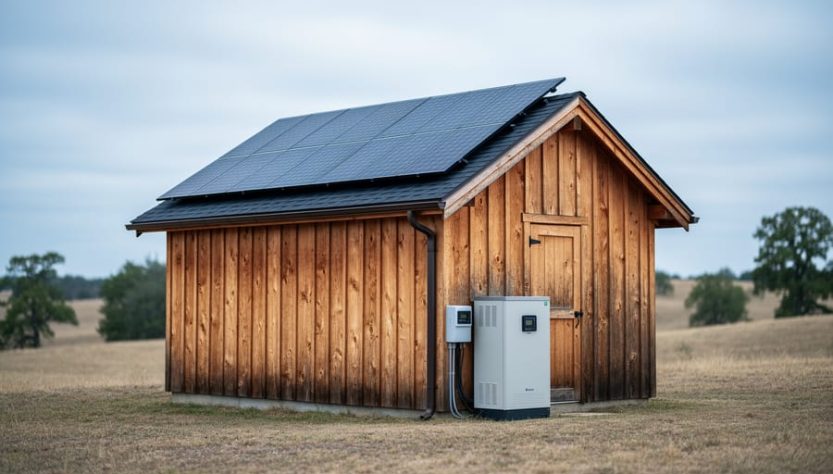
Off-grid solar power is a self-contained electrical system that generates, stores, and supplies electricity independently from the utility grid using photovoltaic panels, batteries, and power management equipment. Unlike grid-tied installations that export surplus energy to power companies, off-grid systems operate in complete isolation, making them the go-to solution for remote cabins, farms beyond transmission infrastructure, and anyone seeking genuine energy independence.
The appeal is straightforward. Conventional electricity access stops where power lines end, often leaving rural properties facing connection fees exceeding $30,000 per mile of extension. Off-grid solar eliminates that cost entirely while providing reliable power in locations where the grid simply doesn’t reach. But the technology also attracts homeowners in grid-served areas who prioritize resilience against outages, reject monthly utility bills, or refuse dependence on centralized energy infrastructure.
Understanding how these systems work requires grasping just four core components: solar panels convert sunlight to DC electricity, charge controllers prevent battery damage, battery banks store energy for nighttime and cloudy days, and inverters transform stored DC power into the AC electricity your appliances need. The elegance lies in how these elements communicate, automatically balancing generation with consumption while protecting your investment from overcharge, deep discharge, and power surges.
This guide strips away the confusion surrounding off-grid solar. You’ll learn the step-by-step operational sequence, decode the essential hardware, explore real-world applications from tiny homes to agricultural operations, and confront the honest tradeoffs between freedom and practicality. Whether you’re planning a remote installation or simply evaluating energy alternatives for 2026, the fundamentals remain accessible to anyone willing to move past the marketing myths.
What Off-Grid Solar Power Means
Off-grid solar power refers to a self-contained electricity generation system that harvests energy from sunlight and operates completely independently of the utility grid. Unlike conventional homes and businesses that draw power from centralized electric companies, an off-grid solar setup produces, stores, and manages all its own electricity on-site through a combination of solar panels, batteries, and power management equipment.
The defining characteristic of an off-grid system is its total autonomy. There’s no physical connection to utility lines, which means no monthly electric bills, no vulnerability to grid outages, and no reliance on fossil-fuel infrastructure. However, this independence also means you’re entirely responsible for generating enough power to meet your needs and maintaining the equipment that makes it possible.
To understand what sets off-grid solar apart, it helps to clarify how it differs from other solar configurations:
- Off-grid
- A standalone solar system with no connection to the utility grid, relying entirely on solar panels and battery storage for all electricity needs.
- Grid-tied
- A solar installation connected to the utility grid that feeds excess power back to the utility and draws grid power when solar production is insufficient, typically without battery backup.
- Hybrid system
- A solar setup that maintains a grid connection for backup purposes while also incorporating battery storage, offering both energy independence and grid reliability.
- Energy autonomy
- The capacity to meet all energy requirements without external supply, achieved through adequate generation and storage resources.
- Islanding
- The ability of a solar system to disconnect from the grid and operate independently during utility outages, a feature available in some hybrid systems but standard in off-grid configurations.
People choose off-grid solar primarily for energy independence and self-sufficiency. Remote properties where grid connection costs are prohibitively expensive represent the most common application. Extending utility lines to a rural cabin or farm can cost tens of thousands of dollars per mile, making off-grid solar the economically sensible choice. Others pursue off-grid systems for philosophical reasons, seeking to minimize their environmental footprint or achieve resilience against infrastructure failures.
The trade-off for this independence is increased responsibility. Off-grid users must carefully manage their electricity consumption to match their system’s production and energy storage capacity. Running high-demand appliances during cloudy weather can deplete batteries faster than they recharge, potentially leaving you without power. This requires a level of energy awareness that grid-tied users rarely consider.
How Off-Grid Solar Systems Work
Energy Generation Phase
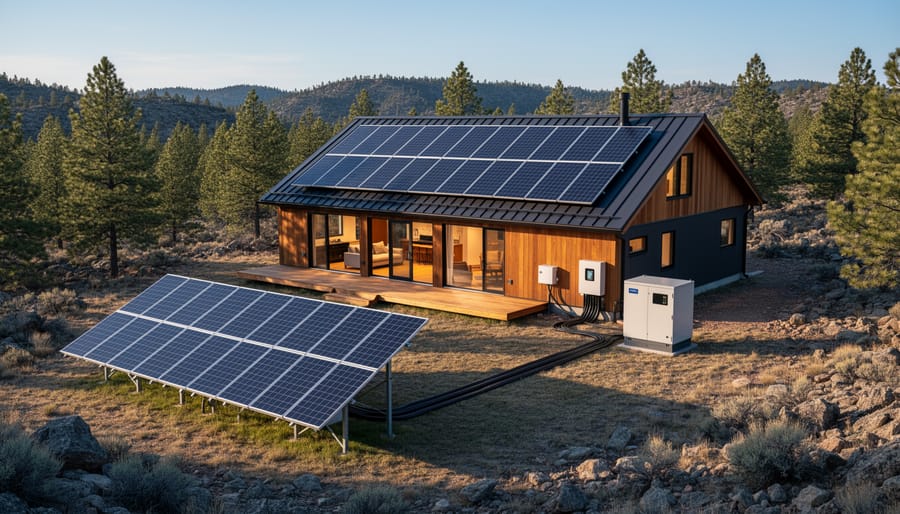
Solar panels generate electricity through the photovoltaic effect, a process where semiconductor materials convert photons from sunlight directly into electrical current. Each panel contains multiple photovoltaic cells, typically made from silicon crystals treated to create positive and negative layers. When sunlight strikes these cells, it knocks electrons loose from their atoms, creating an electric field that forces these electrons to flow in a specific direction, producing direct current electricity.
The amount of power generated varies throughout the day based on sun angle, intensity, and weather conditions. Panels produce peak output during midday when the sun is highest, with reduced generation during morning, evening, and overcast periods. Even on cloudy days, panels still generate electricity, though at 10-25% of their rated capacity depending on cloud density.
Modern solar panels typically convert 15-22% of incoming sunlight into usable electricity, with higher-efficiency models available at premium prices. Multiple panels connected together form an array that scales total generation capacity to meet the system’s design requirements. The DC electricity flows from the panels through wiring to the charge controller, beginning the storage phase.
Storage and Distribution Phase
Once solar panels generate DC electricity, the charge controller acts as the system’s traffic cop, regulating the flow of power into the battery bank. It prevents overcharging during peak sun hours and blocks reverse current drain at night, protecting batteries from damage that would shorten their lifespan. Modern charge controllers also optimize charging based on battery chemistry and temperature conditions.
The battery bank serves as your energy reservoir, storing excess electricity produced during sunny periods for use after dark or during cloudy weather. Battery capacity determines how many days your system can operate without sunlight, typically designed for one to three days of autonomy depending on location and budget. Deep-cycle batteries are engineered specifically for the repeated charge-discharge cycles that off-grid systems demand, unlike automotive batteries which fail quickly under such use.
The inverter completes the circuit by converting stored DC power from batteries into AC electricity that runs standard household appliances. Quality inverters produce clean sine wave output compatible with sensitive electronics like computers and medical equipment. Some systems use a hybrid approach with both AC and DC circuits, running certain loads directly from DC to improve efficiency and reduce inverter load.
Load Management
Load management in off-grid solar systems is essentially the art of matching your energy consumption patterns to your production and storage capabilities. Unlike grid-connected homes where power is always available on demand, off-grid systems require conscious awareness of how much energy you’re using and when.
The system operates within three key constraints: daily solar production limits, finite battery capacity, and instantaneous inverter power ratings. Your charge controller constantly monitors battery state-of-charge, directing excess solar energy into storage when batteries aren’t full and preventing overcharge when they are. During periods of high consumption or low sunlight, the batteries discharge to meet demand, but only to a predetermined depth to preserve battery lifespan.
Effective load management means prioritizing critical loads like refrigeration and water pumping for sunny daytime hours when solar production is active, while reserving evening battery power for essential lighting and communication devices. Many off-grid homeowners implement simple strategies like running washing machines, power tools, and heating systems during peak solar hours rather than at night. Some install programmable timers or smart switches to automate this process.
When batteries approach minimum safe discharge levels, you’ll need to reduce consumption or start a backup generator until solar production resumes. This balancing act becomes second nature with experience.
Essential Components of an Off-Grid Solar System
Solar Panel Arrays
Solar panel arrays form the power-generation heart of any off-grid system. Three main panel technologies suit off-grid applications, each offering distinct trade-offs in efficiency, cost, and durability.
Monocrystalline panels deliver the highest efficiency, typically 18-22%, converting more sunlight into electricity per square metre. Their uniform black appearance and superior low-light performance make them ideal where roof space is limited or sunlight conditions vary. They cost more upfront but require fewer panels to meet your energy targets.
Polycrystalline panels offer a budget-friendly alternative at 15-17% efficiency. Their characteristic blue hue and slightly lower performance mean you’ll need more roof area, but the cost savings can fund larger battery banks or other system components.
Thin-film panels, amorphous silicon, CdTe, or CIGS, provide the lowest efficiency (10-13%) yet excel in extreme heat and partial shading. Their lightweight, flexible construction suits unconventional installations like curved roofs or mobile setups, though you’ll sacrifice space efficiency for installation versatility.
Battery Storage Systems
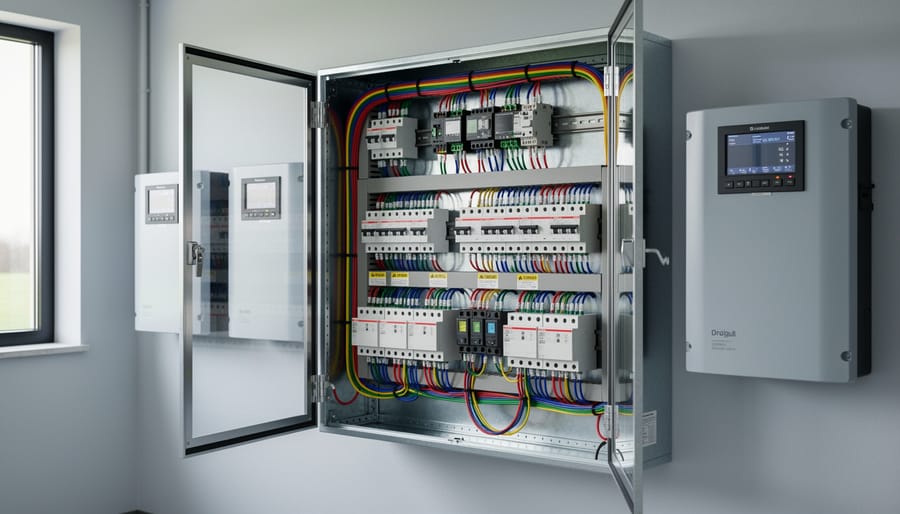
Battery choice shapes system performance and long-term reliability. Lead-acid batteries remain common in off-grid installations due to their lower upfront cost and established track record. Flooded lead-acid types require regular maintenance, checking water levels and ensuring proper ventilation, while sealed AGM and gel variants eliminate maintenance but cost more per kilowatt-hour stored.
Lithium-ion batteries represent the current standard for high-performance off-grid systems. They deliver deeper discharge cycles (typically 80-90% usable capacity versus 50% for lead-acid), weigh considerably less, and last two to three times longer, often 5,000 cycles compared to 1,500 for quality lead-acid. Understanding how batteries work helps you evaluate these trade-offs between chemistry types.
Recent storage innovations include lithium iron phosphate (LiFePO4) batteries, which offer exceptional safety and longevity, and emerging saltwater batteries that eliminate fire risk entirely.
Capacity needs depend on your daily consumption and desired autonomy, most off-grid systems store two to four days’ worth of energy to bridge cloudy periods without running backup generators constantly.
Charge Controllers and Inverters
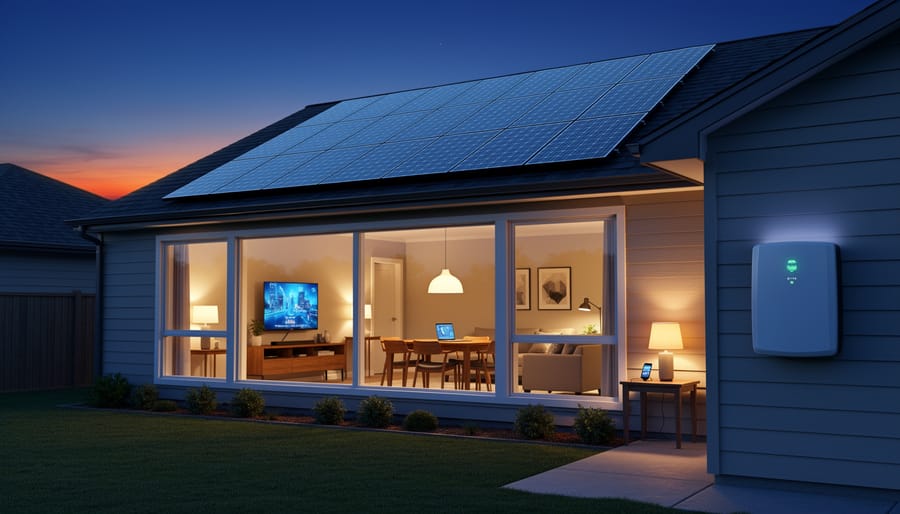
Charge controllers regulate the flow of electricity from your solar panels to your batteries, preventing overcharging and extending battery life. Two main types exist: PWM (Pulse Width Modulation) controllers cost less and work well for smaller systems where panel voltage closely matches battery voltage. MPPT (Maximum Power Point Tracking) controllers extract 20-30% more energy from your panels by efficiently converting higher panel voltages to charging voltage. They’re the better choice for larger systems or when panels and batteries operate at significantly different voltages.
Inverters transform stored DC power into the AC electricity your household appliances require. Pure sine wave inverters produce clean power identical to grid electricity, ensuring sensitive electronics like computers and medical devices function properly without interference or damage. Modified sine wave inverters are cheaper but can cause motors to run hotter, lights to buzz, and certain devices to malfunction.
Size your charge controller by calculating total panel amperage plus a 25% safety margin. Select inverters based on your peak power demand, add up the wattage of appliances you’ll run simultaneously, then choose an inverter rated 20-30% higher.
Backup Power Sources
Even with properly sized battery banks, extended periods of cloudy weather or winter storms can deplete stored energy faster than solar panels can replenish it. This is where backup power sources become essential safety nets for off-grid systems.
Fossil fuel generators, typically propane, diesel, or gasoline models, remain the most common backup solution. A properly integrated generator automatically activates when battery levels drop below a preset threshold, recharging the battery bank while simultaneously powering critical loads. Modern inverter-chargers coordinate this process seamlessly.
Supplementary renewable sources offer cleaner alternatives. Small wind turbines excel during stormy periods when solar production drops, since high winds and heavy clouds often coincide. Micro-hydro systems provide exceptionally reliable backup if you have access to flowing water, even a modest stream can generate continuous power through winter months when solar input is weakest.
The key is matching your backup strategy to local climate patterns and your tolerance for generator noise and fuel costs versus the higher upfront investment of additional renewable capacity.
Where Off-Grid Solar Power Is Used
Off-grid solar power thrives in settings where extending the utility grid is impractical, prohibitively expensive, or simply undesirable. Remote homesteads and cabins represent the most common residential application, properties located miles from the nearest power lines where the cost of grid connection can exceed $30,000 per mile. These installations allow owners to enjoy modern conveniences without sacrificing their preference for rural seclusion or wilderness living.
Rural electrification projects in developing regions demonstrate off-grid solar’s social impact at scale. Communities across sub-Saharan Africa, Southeast Asia, and Latin America bypass traditional grid infrastructure entirely, installing village-scale solar microgrids that provide reliable electricity for homes, schools, and health clinics. These systems deliver transformative benefits, enabling refrigeration for vaccines, lighting for evening study, and power for small businesses, while avoiding the decades-long wait for centralized grid expansion.
Common off-grid solar applications include:
– Remote homesteads and off-grid cabins in areas beyond utility infrastructure
– Recreational vehicles, boats, and mobile living applications requiring portable power
– Agricultural operations powering irrigation pumps, livestock watering systems, and crop monitoring equipment
– Telecommunications towers and remote monitoring stations in isolated locations
– Disaster relief and emergency response scenarios providing rapid power restoration
– Developing regions lacking existing electrical infrastructure
Telecommunications companies rely heavily on off-grid solar to power cell towers and microwave relay stations in mountainous terrain or sparsely populated areas. These installations often incorporate hybrid solar wind configurations to ensure continuous operation regardless of weather patterns, maintaining connectivity where grid power is unavailable or unreliable.
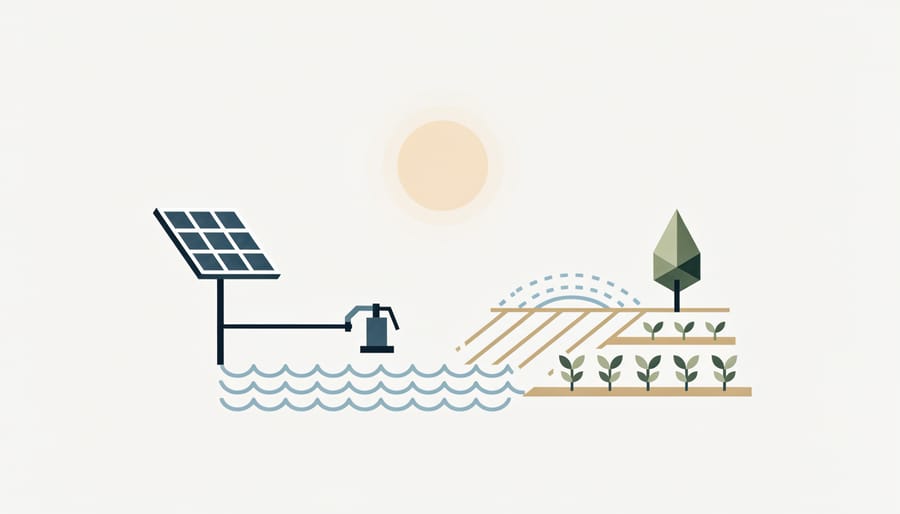
Agricultural operations adopt off-grid solar for specific high-value applications. Irrigation pumps drawing from wells or streams run on solar power during peak daylight hours when crops need water most. Livestock ranchers install solar-powered watering systems across vast grazing lands where trenching power lines makes no economic sense. Vineyards and orchards use solar installations to power frost protection systems and automated monitoring equipment without monthly utility bills.
Emergency backup systems represent a growing application category. Critical facilities including fire stations, emergency shelters, and medical clinics install off-grid solar as primary backup power, eliminating dependence on diesel generators with their fuel logistics and maintenance demands. These systems activate automatically during grid outages, maintaining essential services when communities need them most.
Mobile applications span recreational vehicles, marine vessels, and expedition equipment where portability and self-sufficiency matter. Modern RVs routinely feature roof-mounted solar arrays providing enough power for extended off-grid camping, while sailboats rely on solar panels to maintain navigation systems, refrigeration, and communications during ocean passages.
Advantages and Considerations
Off-grid solar power delivers genuine energy independence, your system runs entirely on sunlight you capture and store, making you immune to utility rate hikes, grid failures, and power company policies. In remote areas where grid extension costs tens of thousands of dollars per mile, off-grid solar often represents the only economically sensible electrification option. The environmental benefits are straightforward: zero ongoing carbon emissions during operation, no fuel combustion, and a system that typically offsets its manufacturing footprint within three to five years of use.
This autonomy extends beyond convenience. Households in wildfire-prone regions maintain power during preemptive utility shutoffs, while rural properties gain reliable electricity without waiting years for grid infrastructure. Off-grid systems also enable sustainable living practices, from solar cooking to electric vehicle charging, powered entirely by renewable energy you control.
The financial reality demands honest consideration. Expect $15,000 to $40,000 for a properly sized residential system before installation, with battery banks alone consuming 30 to 50 percent of that budget. These batteries require replacement every 5 to 15 years depending on chemistry and use patterns, representing a significant ongoing expense that grid-tied households never face.
Energy discipline becomes non-negotiable. You can’t simply run every appliance simultaneously without consequence, your system has finite daily production and storage. Running a clothes dryer during three consecutive cloudy days will drain batteries that took weeks of surplus generation to fully charge. This means actively monitoring consumption, timing heavy loads for sunny periods, and accepting that some high-draw conveniences may require propane or alternative solutions.
Maintenance responsibilities shift entirely to you. No utility crew arrives to troubleshoot issues, you’ll need to understand your system, keep panels clear of snow and debris, check battery water levels if using flooded lead-acid technology, and identify problems before they cascade into failures. Many off-grid households maintain backup generators not for daily use, but as insurance during extended low-production periods or equipment failures. This self-reliance appeals to some users and burdens others; assess honestly which category fits you before committing to off-grid living.
Frequently Asked Questions
Off-grid solar systems spark plenty of questions from prospective users evaluating whether complete grid independence suits their situation. Here are answers to the most common queries.
What should I expect to pay for an off-grid solar system?
A complete residential off-grid system typically ranges from $20,000 to $60,000 depending on energy needs, battery capacity, and component quality. Systems for small cabins start around $10,000, while larger homes with higher consumption can exceed $80,000.
How long do off-grid solar systems last?
Solar panels carry 25-year warranties and often produce power for 30-40 years. Battery banks require replacement every 5-15 years depending on type, lithium-ion lasts longer than lead-acid, while charge controllers and inverters typically last 10-15 years.
Will my system work during winter or cloudy weather?
Yes, but production drops significantly during short winter days and overcast periods. Proper system sizing accounts for seasonal variations by oversizing the panel array and battery capacity to cover extended low-sun stretches, often with a backup generator for worst-case scenarios.
Do I need permits to install an off-grid solar system?
Requirements vary by location, but most jurisdictions require building permits for electrical work and sometimes zoning approval for ground-mounted arrays. Some rural areas have minimal regulations, while others enforce the same codes as grid-tied installations.
Can you expand an off-grid system over time? Absolutely. Start with a modular design that accommodates additional panels and batteries as your needs grow or budget allows. Ensure your charge controller and inverter have sufficient capacity headroom, or plan to upgrade those components when scaling up. Many users begin with a minimal system covering essential loads, then expand once they understand their actual consumption patterns and seasonal energy demands. This phased approach spreads costs and reduces the risk of over-building capacity you don’t need.
Off-grid solar power represents a proven pathway to genuine energy independence. When designed with care and matched to realistic consumption patterns, these systems deliver reliable electricity far from utility infrastructure while eliminating monthly power bills and reducing environmental impact.
The technology has matured significantly. Modern components offer improved efficiency, longer lifespans, and decreasing costs compared to early systems. Battery storage advances have addressed previous limitations around capacity and cycling durability. Charge controllers and inverters now incorporate smart monitoring features that optimize performance automatically. What once required specialized knowledge has become more accessible to homeowners willing to invest time in understanding their energy requirements.
Success with off-grid solar hinges on honest assessment. Calculate your actual power needs rather than replicating grid-connected consumption habits. Factor in upfront system costs, ongoing maintenance responsibilities, and the discipline required to manage finite stored energy during low-production periods. Remote cabin installations demand different sizing than year-round family homes. Undersized systems create frustration; oversized systems waste capital.
For those prepared to embrace these realities, off-grid solar opens doors that grid expansion cannot reach. It enables sustainable living in remote locations, protects against infrastructure failures, and demonstrates practical climate action. As component costs continue falling and efficiency improves, this once-niche technology moves steadily into the mainstream, offering more people the opportunity to power their lives directly from sunlight.