

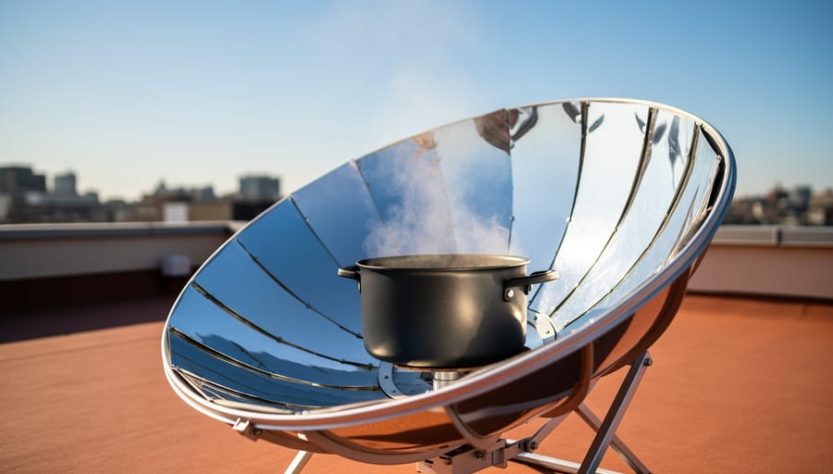
Solar cooking uses focused or trapped sunlight to generate heat sufficient for preparing food, typically reaching temperatures between 150°C and 400°C depending on cooker design and atmospheric conditions. At its core, the technology harnesses three fundamental principles: concentrating solar radiation onto a cooking vessel, converting light into thermal energy through absorption, and retaining that heat to maintain cooking temperatures.
The appeal of solar cooking extends far beyond novelty. In regions where fuel is scarce or expensive, solar cookers provide a zero-emission alternative that eliminates the health hazards of indoor smoke from traditional biomass stoves. For humanitarian organizations and climate-focused policymakers, the technology represents a scalable solution to reduce deforestation and carbon emissions while improving food security. Even in developed economies, solar cooking offers off-grid resilience and a practical application of renewable energy principles.
Understanding how solar cooking functions requires examining the interplay of optics, thermodynamics, and materials science. Reflective surfaces redirect sunlight toward a focal point, dark cookware absorbs visible light and re-emits it as infrared heat, and insulated enclosures trap that warmth to sustain cooking processes. Different cooker architectures optimize these mechanisms for specific applications, from rapid boiling in parabolic concentrators to slow roasting in insulated box designs. For a broader context on this technology’s potential, see our solar cooking overview.
This article explains the physical mechanisms that make solar cooking viable, categorizes the main equipment types by their thermodynamic performance, and situates the technology within current energy access and climate mitigation strategies. The science is straightforward, the hardware is mature, and the applications are expanding across diverse climates and user contexts.
What Solar Cooking Means
Solar cooking is a method of food preparation that harnesses direct sunlight and converts it into sufficient thermal energy to cook meals without conventional fuels. Instead of burning wood, charcoal, gas, or using electricity, solar cookers capture incoming solar radiation through reflective or absorptive surfaces, concentrate that energy within an insulated chamber or onto a cooking vessel, and generate temperatures high enough to bake, boil, steam, or roast food.
The core principle involves three sequential steps: collection, conversion, and retention. A solar cooker first collects sunlight using mirrors, polished metal panels, or transparent glazing. It then converts visible and infrared radiation into heat when photons strike dark-coloured pots or absorptive surfaces inside the device. Finally, it retains that thermal energy through insulation and transparent covers that create a greenhouse effect, trapping warm air and preventing convective losses. Depending on the design, solar cookers can reach temperatures between 150°F and 400°F (65°C to 200°C), with some high-performance parabolic models exceeding these ranges in optimal conditions.
Understanding the basic terminology clarifies how the technology operates:
- Solar radiation
- Electromagnetic energy emitted by the sun, including visible light and infrared wavelengths that carry heat. Solar cookers capture this radiation and redirect it for thermal use.
- Thermal energy conversion
- The process by which absorbed sunlight transforms into heat within a material, raising its temperature and enabling cooking.
- Solar aperture
- The opening or surface area through which sunlight enters the cooker. A larger aperture collects more energy but may require more material and space.
- Heat retention
- The cooker’s ability to trap and hold thermal energy using insulation, sealed chambers, or transparent lids that minimize heat loss to the surrounding environment.
- Reflective surfaces
- Mirrors, polished aluminum, or metallic coatings that bounce incoming sunlight toward a focal point or cooking chamber, increasing energy concentration.
This approach differs fundamentally from conventional cooking, which relies on combustion or electrical resistance to generate heat. Solar cooking produces no emissions, requires no fuel purchases or supply chains, and operates silently with minimal maintenance. These characteristics make it especially valuable as renewable energy in developing countries where access to electricity is limited, firewood is scarce, and reducing indoor air pollution from open fires can yield immediate health benefits. Humanitarian organizations and sustainable development programs have deployed solar cookers in refugee settlements, rural schools, and off-grid communities, demonstrating the technology’s role in advancing energy access and environmental resilience.
The Science Behind Solar Cooking
Solar cooking harnesses three interconnected heat-transfer mechanisms to convert sunlight into usable cooking energy: concentration through reflection, absorption that transforms light into thermal energy, and retention via insulation. Understanding these principles explains both the technology’s capabilities and its practical limitations.
The first mechanism, concentration, uses reflective surfaces to redirect and focus sunlight toward a cooking vessel. Polished aluminum, mirrored glass, or metallized film panels act as solar collectors, bouncing incoming radiation from a wide area onto a smaller target zone. This concentration multiplies the energy density at the cooking surface. Box cookers typically use flat or angled reflectors to increase light entering the cooking chamber, while parabolic designs focus rays to a single high-intensity point. The reflector’s surface quality and geometry directly determine how much solar energy reaches the cooking pot. Even minor misalignment or surface degradation reduces efficiency measurably.
Absorption, the second mechanism, occurs when concentrated sunlight strikes the cooking vessel. Dark-colored materials excel at this conversion because they absorb across the visible spectrum rather than reflecting light away. Black pots can reach surface temperatures 50-70°F higher than shiny metal containers under identical conditions. The absorbed photons excite molecules in the pot’s material, generating kinetic energy that manifests as heat. This thermal energy then transfers to the food through conduction. Cooking vessels with matte black exteriors optimize this absorption phase, which is why experienced solar cooks often paint standard cookware or select purpose-built dark containers.
Retention completes the system by trapping the generated heat and minimizing losses to the surrounding environment. Transparent covers made from tempered glass or heat-resistant plastic create a greenhouse effect, allowing short-wavelength visible light to enter while blocking long-wavelength infrared radiation from escaping. Insulated walls, typically constructed from materials like fiberglass, foam, or cardboard, reduce conductive and convective heat loss through the cooker’s sides and base. This thermal retention allows temperatures to build gradually and maintain stability even as ambient conditions fluctuate. Well-insulated box cookers can hold internal temperatures 150-200°F above outside air temperature.
Performance depends heavily on sun angle and atmospheric conditions. Maximum efficiency occurs when sunlight strikes the reflector surface at a perpendicular angle, typically requiring adjustment every 30-60 minutes as the sun tracks across the sky. Lower sun angles in winter or at high latitudes reduce available energy and cooking speed. Cloud cover, humidity, and airborne particulates scatter and absorb incoming radiation before it reaches the cooker, cutting performance by 40-80% depending on density. Wind increases convective losses from the cooking chamber, particularly in designs with less effective insulation. These variables explain why solar cooking works best in arid, high-altitude regions with clear skies and strong direct sunlight, conditions common in the solar belt between 35°N and 35°S latitude.
Types of Solar Cookers
Box Cookers
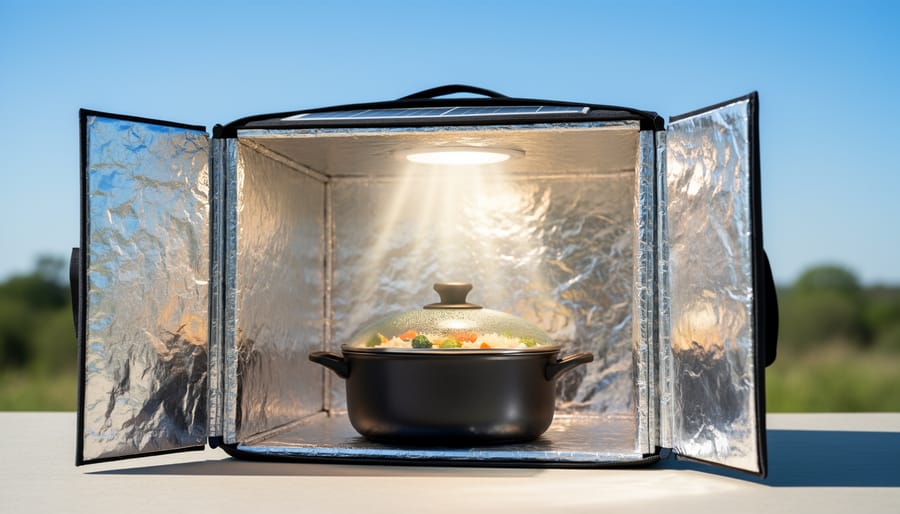
Box cookers represent the most widely adopted solar cooking design, favored for their reliability and forgiving operation. These devices consist of an insulated box, often constructed from cardboard, wood, or metal, lined with reflective material such as aluminum foil. A transparent lid, typically glass or heat-resistant plastic, covers the top to create a greenhouse effect that traps infrared radiation inside the chamber.
One or more external reflective panels direct additional sunlight through the lid, boosting interior temperatures. Most box cookers reach 150-300°F (65-150°C), sufficient for slow-cooking methods that mirror conventional oven techniques. The insulated walls function similarly to thermal energy storage systems, retaining accumulated heat even when cloud cover temporarily blocks direct sunlight.
Cooking times extend longer than conventional methods, a pot of rice requiring 20 minutes on a stove may take 60-90 minutes in a box cooker, but the technology excels at unattended cooking. Users can place food inside in the morning and return hours later to a fully cooked meal without risk of burning. This passive approach aligns with principles familiar from energy storage basics: capturing energy when available and releasing it gradually as needed.
Box cookers handle stews, casseroles, rice, beans, and baked goods effectively. Their capacity typically ranges from 2-6 liters, accommodating family-sized portions. Many designs fold flat or disassemble for transport, making them practical for both permanent installations and field deployment in humanitarian contexts.
Panel Cookers
Panel cookers represent the most accessible entry point into solar cooking technology, combining simplicity with practical performance. These devices use flat or curved reflective panels, typically aluminum foil or metallized cardboard, arranged to direct and concentrate sunlight onto a dark cooking pot placed at their focal center. The pot sits inside a clear heat-resistant bag or glass bowl that traps infrared radiation, creating a greenhouse effect that elevates cooking temperatures.
Most panel cooker designs fold flat for storage and transport, weighing less than five pounds. Their reflective surfaces channel sunlight from multiple angles toward the cooking vessel, achieving temperatures between 200-300°F (95-150°C) under optimal conditions. This range suits simmering, steaming, and slow-cooking applications, rice, beans, vegetables, and soups perform well, though high-heat techniques like frying remain impractical.
The primary advantages lie in affordability and portability. Panel cookers cost $15-50 for commercial models, and DIY versions can be constructed from cardboard and foil for under $10. They require minimal maintenance and no complex tracking mechanisms, though periodic repositioning toward the sun improves efficiency.
Performance limitations include moderate cooking speeds, expect 1.5-3 hours for typical meals, and reduced effectiveness during overcast conditions or low sun angles. Wind can destabilize lightweight designs, and the exposed cooking vessel loses heat more readily than insulated box cookers. Panel cookers excel in emergency preparedness kits, outdoor recreation, and educational demonstrations where portability outweighs cooking speed. Development organizations have successfully deployed them in communities transitioning from open-fire cooking, where their low cost and durability support widespread adoption.
Parabolic Cookers
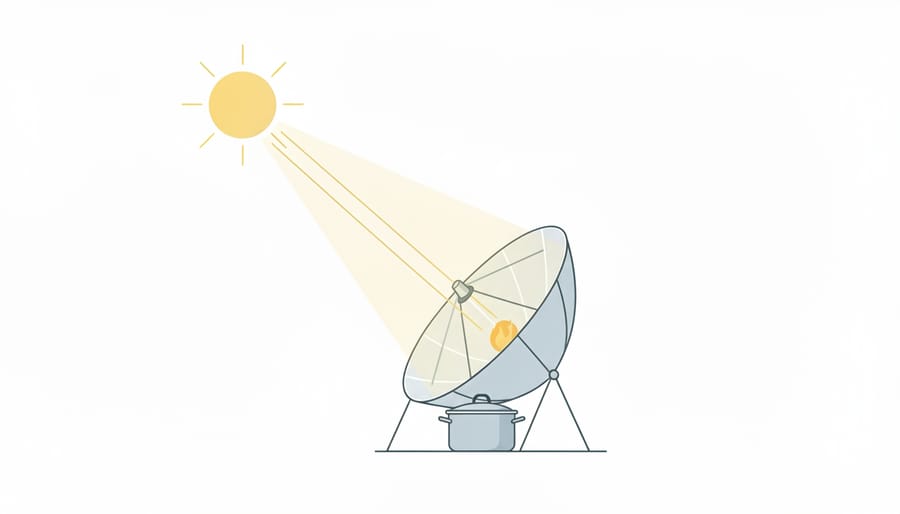
Parabolic cookers represent the most powerful category of solar cooking technology, employing curved reflective surfaces shaped like satellite dishes to concentrate sunlight onto a single focal point. This geometric configuration can achieve temperatures exceeding 400°F (200°C), rivaling conventional stovetops and enabling cooking methods that other solar designs cannot accommodate. The concentrated heat allows for frying, sautéing, grilling, and rapid boiling, techniques that typically require intense, direct heat.
The parabolic design functions by redirecting parallel rays of sunlight from across the entire reflective surface to converge at a focal point where the cooking vessel sits. This concentration effect amplifies the energy density dramatically: a 1.4-meter parabolic cooker can deliver heat equivalent to a 2,000-watt burner under optimal conditions. Users can bring water to a rolling boil in minutes and cook meat with the browning and searing characteristics of traditional high-heat methods.
However, this performance comes with operational demands. Parabolic cookers require precise alignment with the sun, and as the sun moves across the sky, the cooker must be repositioned every 15 to 30 minutes to maintain peak efficiency. The intense focal heat also presents safety hazards: accidental contact with the focal point can cause immediate burns, and the bright reflection can damage eyesight if viewed directly. Many commercial models include adjustable stands and protective shields to address these concerns.
These characteristics make parabolic cookers well-suited for institutional kitchens, outdoor catering operations, and commercial food preparation in sunny climates. Relief organizations have deployed them in refugee settlements where rapid meal preparation for large groups is essential. Professional solar cooking training programs emphasize safety protocols and sun-tracking techniques to maximize both performance and user protection.
Practical Applications and Uses
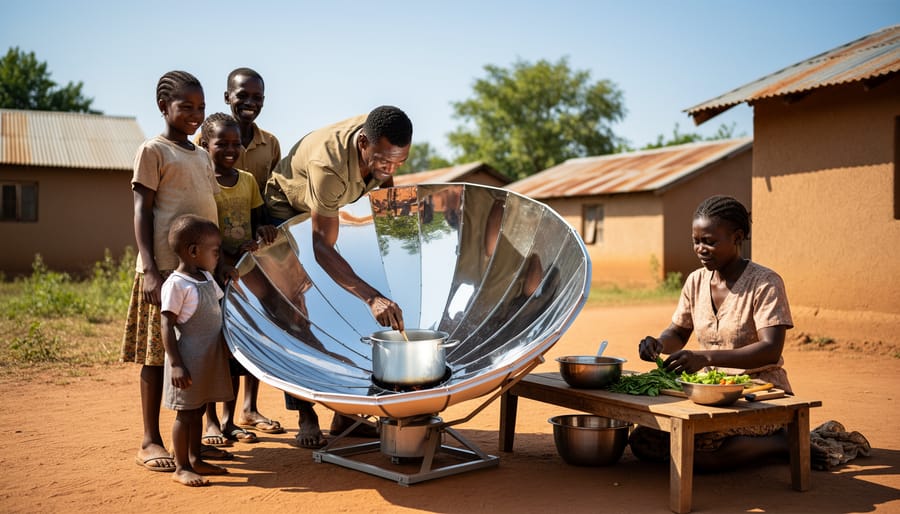
Solar cooking technology has moved beyond experimental prototypes to serve critical functions in diverse settings worldwide. In refugee camps across East Africa, organizations like Solar Cookers International have distributed thousands of panel and box cookers to displaced families, reducing their dependence on scarce firewood and decreasing exposure to violence during fuel-gathering trips. The Kakuma Refugee Camp in Kenya, for example, integrated solar cookers into its food security programs in 2024, enabling residents to prepare meals without depleting surrounding vegetation or incurring fuel costs.
School feeding programs in India and Bolivia have adopted institutional-scale parabolic cookers capable of preparing meals for hundreds of students daily. These installations demonstrate solar cooking’s viability at community scale while providing educational opportunities for students to engage with renewable energy principles. In urban contexts, rooftop solar kitchens have emerged in cities like Ahmedabad and Barcelona, where space constraints and pollution concerns make solar in cities particularly valuable for reducing cooking-related emissions.
The technology finds application across multiple sectors:
- Humanitarian relief operations in disaster zones and conflict areas
- Remote communities without access to electricity or fossil fuel distribution networks
- Outdoor recreation including camping, hiking, and off-grid living
- Educational demonstrations in schools and renewable energy training centers
- Emergency preparedness kits for power outages and natural disasters
Environmental benefits extend beyond carbon reduction. Field studies in Haiti documented 60% decreases in household firewood consumption among solar cooker adopters, slowing deforestation rates in vulnerable watersheds. Indoor air quality improvements prove equally significant. The World Health Organization estimates that traditional cooking methods cause 3.2 million premature deaths annually from household air pollution, a burden solar cooking directly addresses by eliminating combustion smoke.
Climate adaptation strategies increasingly recognize solar cooking as a resilience tool. The International Renewable Energy Agency’s 2025 report on distributed energy solutions identified solar thermal cooking as a low-cost intervention for climate-vulnerable populations facing fuel scarcity and extreme heat events that make indoor cooking with conventional stoves dangerous.
Frequently Asked Questions
What can you cook in a solar cooker?
Solar cookers handle most conventional cooking tasks including rice, beans, stews, vegetables, bread, and even pasteurizing water. Box cookers excel at slow-cooking dishes, while parabolic models can fry eggs or grill meat at high temperatures.
How long does solar cooking take compared to conventional methods?
Solar cooking typically takes 1.5 to 3 times longer than conventional cooking, depending on the cooker type and weather conditions. A pot of rice that cooks in 20 minutes on a gas stove might require 45-60 minutes in a box cooker or 30-40 minutes in a parabolic cooker under optimal sun.
Can solar cookers work in cloudy or cold weather?
Solar cookers require direct sunlight to function effectively. Partial cloud cover significantly reduces performance, and heavy overcast conditions make cooking impractical. Cold ambient temperatures have minimal impact as long as strong sunlight is available, though cooking times may increase slightly.
What are the main safety considerations?
Parabolic cookers create intense focal heat that can cause burns or eye damage if looked at directly, requiring protective eyewear. All solar cookers produce hot surfaces and cookware that demand careful handling. Position cookers away from children and pets, and never leave reflective surfaces unattended in direct sun.
How much do solar cookers cost?
Panel cookers start around $25-50, box cookers range from $100-300, and parabolic models typically cost $200-500. DIY construction from cardboard, foil, and glass can reduce costs to under $20 for basic designs.
Are solar cookers suitable for urban environments?
Urban settings work well if you have access to a balcony, rooftop, or yard with several hours of unobstructed sunlight. Apartment dwellers with south-facing balconies can use compact panel or box cookers, though tall buildings and shade from surrounding structures limit effectiveness.
These practical considerations matter most when evaluating whether solar cooking fits your context. Performance varies with geography, equatorial and arid regions offer year-round viability, while higher latitudes face seasonal constraints. The technology suits supplemental cooking in most climates rather than complete fuel replacement, though daily use proves feasible in sun-rich areas with proper planning around weather patterns.