


Renewable energy credits represent a market-based instrument that quantifies and trades the environmental attributes of clean electricity generation, enabling organizations to claim renewable energy use even when they cannot directly access green power sources. Each credit corresponds to one megawatt-hour of electricity generated from renewable sources and can be bought, sold, or retired independently of the physical electricity itself. This separation allows companies in Ontario to purchase credits generated by wind farms in Alberta, for instance, supporting the growth of renewable energy in Canada while meeting sustainability commitments.
Canada’s approach to renewable energy credits differs significantly from the United States model. Rather than operating a unified national system, provincial frameworks govern most credit trading activity. British Columbia’s Low Carbon Fuel Standard, established in 2010 and continuously refined through 2026, exemplifies how these mechanisms function within Canadian jurisdictions. The program requires fuel suppliers to reduce the carbon intensity of their products, creating tradable credits for renewable energy adoption in transportation.
Understanding how these credits operate matters now more than ever. As corporations face mounting pressure to demonstrate verifiable climate action, renewable energy credits provide measurable proof of environmental investment. The introduction of blockchain technology for credit tracking in several Canadian provinces since 2024 has addressed longstanding concerns about double-counting and transparency, strengthening market confidence.
This article examines the fundamental mechanics of renewable energy credits, explores how Canadian provincial systems implement these instruments, and provides practical guidance for organizations considering market participation. Whether you’re evaluating credits for corporate sustainability goals or assessing policy effectiveness, grasping these mechanisms is essential for informed decision-making in 2026’s evolving energy landscape.
What Are Renewable Energy Credits?
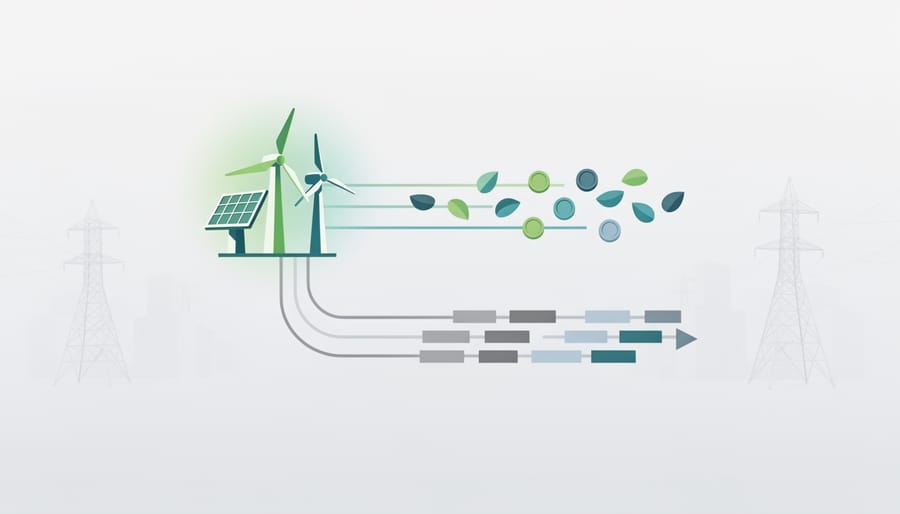
Renewable energy credits serve as proof of clean power production. Each credit, often called a REC, represents one megawatt-hour of electricity generated from renewable sources like wind, solar, or hydroelectric power. The system creates a tradable certificate that captures the environmental value of that generation, separate from the actual electrons flowing through the grid.
This separation is the mechanism’s core innovation. When a wind farm produces electricity, it creates two distinct products: the physical power itself and the environmental attributes tied to that carbon-free generation. The power enters the grid and mixes with electricity from all sources. The REC, meanwhile, becomes a tradable instrument that proves someone, somewhere generated clean energy. One credit equals one MWh of renewable generation, with RECs issued per MWh documenting the specific characteristics of that production.
Each certificate contains three critical pieces of information: how the energy was produced (the renewable technology used), where it was generated (the facility location), and when it entered the grid (the production timestamp). This data trail establishes the credit’s legitimacy and value in compliance and voluntary markets.
- Retirement
- The permanent removal of a REC from circulation after it has been claimed by an organization, preventing double-counting of environmental benefits.
- Environmental Attributes
- The carbon reduction and renewable generation claims associated with clean energy production, which can be owned separately from the physical electricity.
- Additionality
- The principle that a renewable energy project would not have been built without the revenue stream provided by REC sales.
- Renewable Energy Generation
- Electricity produced from naturally replenishing sources that emit zero or minimal greenhouse gases during operation.
The final step determines who gets to claim the environmental benefit. RECs are retired or redeemed in favor of a single organization, which then owns the right to say it supported that specific unit of clean energy production. Without retirement, a credit remains in circulation and carries no claim value. This redemption process prevents multiple parties from claiming credit for the same renewable generation, maintaining the system’s integrity and ensuring that emission reductions aren’t counted twice.
The Canadian REC Landscape: Provincial Approaches

British Columbia’s Low Carbon Fuel Standard
British Columbia’s Low Carbon Fuel Standard operates through the Low Carbon Fuels Act and its two supporting regulations, creating one of Canada’s most comprehensive frameworks for incentivizing cleaner transportation fuels. The system works by establishing requirements that encourage fuel suppliers to shift toward renewable and low-carbon alternatives while providing financial incentives proportional to the environmental benefits they deliver.
At the heart of BC’s approach is a performance-based mechanism: suppliers who provide renewable fuels generate credits based on how significantly those fuels reduce greenhouse gas emissions compared to their conventional counterparts. A supplier offering advanced biodiesel that cuts emissions by 80 percent receives substantially more credits than one providing ethanol with a 40 percent reduction. This tiered structure drives continuous improvement, rewarding innovations that achieve deeper carbon cuts rather than treating all renewable fuels as equivalent.
The standard applies across BC’s transportation fuel sector, requiring distributors of gasoline and diesel to either supply qualifying low-carbon fuels themselves or purchase credits from those who do. Renewable energy sources feeding into this system range from agricultural waste converted to biogas to hydrogen produced through electrolysis, and understanding how wind power works becomes relevant when wind-generated electricity powers charging infrastructure or hydrogen production facilities that earn credits under the framework.
BC’s credit market enables trading between participants, creating flexibility for fuel suppliers to meet their obligations through whichever pathway proves most economically efficient. A petroleum distributor unable to blend sufficient low-carbon content can purchase credits from a renewable diesel producer or electric vehicle charging network operator who has generated a surplus. This trading mechanism establishes a price signal that makes carbon reduction financially tangible, channeling investment toward the cleanest fuel technologies.
The framework includes compliance periods and reporting requirements that ensure accountability, with the provincial government maintaining a registry to track credit generation, transfers, and retirement. When an organization retires credits to meet its regulatory obligations, those credits exit circulation permanently, cementing the environmental benefit rather than allowing indefinite resale.
Other Provincial Frameworks
While British Columbia has developed one of Canada’s most comprehensive low-carbon fuel frameworks, other provinces have taken different paths in addressing renewable energy and emissions reduction. Alberta operates the Technology Innovation and Emissions Reduction (TIER) system, which focuses on large industrial emitters and creates performance credits when facilities reduce emissions below established benchmarks. This approach differs fundamentally from BC’s fuel-specific standard, targeting emissions intensity across industrial operations rather than transportation fuels.
Ontario’s approach has evolved through various iterations, with the province having previously operated a cap-and-trade system before its cancellation in 2018. Currently, Ontario emphasizes renewable energy procurement through long-term contracts and the Independent Electricity System Operator’s programs, though without a unified low-carbon fuel standard comparable to BC’s framework. The province’s renewable energy market operates primarily through direct power purchase agreements and contracted generation.
Quebec maintains its own cap-and-trade system linked with California’s market, creating carbon credits that function differently from renewable energy credits but serve similar emissions reduction goals. The province also requires petroleum product distributors to include increasing percentages of renewable content in gasoline and diesel through its Regulation respecting the renewable content of fuel.
These varied provincial approaches reflect Canada’s constitutional structure, where energy policy falls largely under provincial jurisdiction. The absence of a federal REC system means organizations operating nationally must navigate multiple frameworks, each with distinct mechanisms, compliance requirements, and credit structures tailored to regional energy priorities and political commitments.
How the Credit Market Functions
The credit market operates as a structured yet dynamic system where renewable energy attributes change hands independently of the electrons themselves. Understanding this separation is key: when a solar farm generates power, it produces both physical electricity and the environmental claim to that clean generation. The market mechanism allows these claims to be tracked, valued, and transferred.
Credit generation begins at the point of renewable energy production. When a qualifying facility generates one megawatt-hour of clean electricity, the corresponding environmental attributes can be converted into a tradable instrument. Within British Columbia’s Low Carbon Fuel Standard framework, the value of these credits directly correlates with the greenhouse gas emission reductions achieved compared to conventional fuel benchmarks. A renewable diesel supplier that cuts emissions by 70 percent relative to petroleum diesel, for instance, generates more valuable credits than one achieving a 30 percent reduction.
The lifecycle of a credit follows a clear sequence:
- Renewable energy generation occurs at a qualifying facility, creating both physical power and separable environmental attributes
- Credits are created and registered in a tracking system that records the generation source, timing, location, and emission reduction characteristics
- Market listing happens when holders decide to sell, either through bilateral agreements or organized trading platforms where buyers can assess available credits
- Purchase and transfer completes when a buyer acquires credits, with ownership changing hands through documented transactions that update the registry
- Retirement finalizes the process when the purchasing organization claims the environmental benefits, permanently removing the credit from circulation and preventing double-counting
Market dynamics reflect supply from renewable energy producers and demand from organizations seeking to demonstrate clean energy use or meet regulatory obligations. Prices fluctuate based on credit availability, regulatory requirements, and the emission reduction intensity of the underlying renewable generation. In British Columbia’s credit market specifically, fuel suppliers facing compliance obligations under the Low Carbon Fuel Standard create consistent demand, while renewable and low-carbon fuel providers generate the supply.
The retirement step deserves emphasis. Until a credit is formally retired in favour of a specific organization, the environmental claim remains transferable. Only retirement locks in the benefit to one entity and enables legitimate sustainability reporting. This prevents the same megawatt-hour of renewable generation from being claimed multiple times by different parties, maintaining the integrity that makes the entire market function.
Who Benefits from Renewable Energy Credits?
Renewable energy credit systems create value for multiple stakeholder groups, each with distinct motivations and benefits.
**Renewable Energy Producers** gain a crucial secondary revenue stream beyond selling electricity itself. When a wind farm or solar installation generates power, it creates both the physical electricity and the associated environmental attributes. By selling RECs separately, producers unlock additional income that improves project economics and accelerates return on investment. This revenue boost makes marginal projects financially viable and encourages expansion of renewable capacity across Canada.
**Corporate Buyers and Organizations** purchase RECs to demonstrate environmental leadership and meet sustainability commitments. A manufacturing facility in Ontario, for instance, might buy credits from a Quebec wind project to offset its electricity consumption and claim renewable energy use in annual reports. This allows organizations to reduce their reported carbon footprint without necessarily changing their physical power sources, a flexibility particularly valuable where direct renewable procurement isn’t feasible. Companies also use RECs to meet voluntary sustainability targets, satisfy stakeholder expectations, and differentiate themselves in increasingly climate-conscious markets.
**The Broader Energy Market** benefits through accelerated clean energy deployment. The additional revenue RECs provide strengthens the business case for new renewable projects, particularly those that face challenges like intermittent generation or the need for energy storage for renewables. Credit markets also create price signals that reflect environmental value, guiding investment decisions toward lower-emission technologies. In BC’s Low Carbon Fuel Standard framework, these market dynamics directly incentivize fuel suppliers based on emission reductions compared to conventional alternatives.
Provincial governments gain a policy tool that drives decarbonization without direct subsidies, while consumers benefit indirectly from increased renewable capacity that can stabilize long-term energy costs and reduce grid emissions over time.
Blockchain’s Role in Modernizing REC Systems
Blockchain technology is reshaping how renewable energy credits move through Canadian markets by addressing long-standing challenges in verification and trust. Traditional REC systems rely on centralized registries and manual reconciliation processes that can be slow, opaque, and vulnerable to double-counting errors. Distributed ledger technology creates an immutable record of each credit’s generation, ownership transfers, and eventual retirement, making the entire lifecycle visible to authorized participants without requiring a single controlling authority.
The transparency gains are substantial. When a renewable energy facility generates power, the corresponding REC can be recorded on a blockchain with timestamps, location data, and generation method automatically verified through smart contracts. Every subsequent transaction, whether a sale, transfer, or retirement, becomes a permanent entry that cannot be altered retroactively. This creates an audit trail that regulators, buyers, and sellers can verify independently, reducing the friction that often surrounds compliance reporting and sustainability claims.
Several pilot projects across Canada are testing these concepts in practice. Energy companies and technology providers have launched initiatives that tokenize renewable energy credits, allowing them to be traded on blockchain platforms with settlement occurring in minutes rather than days. These systems use smart contracts to automatically execute transfers when predefined conditions are met, eliminating the manual processing that traditionally delays transactions. The technology also shows promise for cross-border credit trading, where differing provincial frameworks have historically created complexity, a blockchain-based system can maintain compliance records for multiple jurisdictions simultaneously.
The fraud prevention capabilities matter particularly in markets where environmental claims carry financial value. Because each REC exists as a unique digital token on the blockchain, the system inherently prevents the same credit from being sold multiple times or claimed by different entities. When an organization retires a credit to claim its environmental benefits, that retirement is recorded permanently and visible to all network participants.
Implementation remains in early stages. While the technology demonstrates clear potential for streamlining REC markets, widespread adoption requires coordination between provincial regulators, existing registry operators, and market participants. The systems being piloted in 2026 focus on interoperability, ensuring blockchain-based credits can integrate with traditional registries and meet established regulatory requirements without creating parallel markets that fragment liquidity.

Practical Implications for Canadian Organizations
Canadian organizations evaluating REC participation face three key decision areas: strategic procurement, regulatory compliance, and public sustainability commitments. The approach you take depends on whether you’re pursuing voluntary environmental goals or meeting mandatory requirements.
For procurement strategy, start by assessing your organization’s energy profile and sustainability objectives. Some organizations purchase RECs to offset electricity consumption at facilities where direct renewable sourcing isn’t feasible. Others integrate RECs into broader decarbonization strategies alongside energy efficiency improvements and on-site generation. The critical choice is between bundled purchases (buying renewable electricity and its associated credits together) and unbundled RECs (purchasing credits separately from your power supply). Bundled arrangements typically offer stronger sustainability claims but require longer-term commitments and may limit supplier options.
Provincial compliance programs create specific opportunities. In British Columbia, organizations supplying transportation fuels can leverage the Low Carbon Fuel Standard’s credit system to meet regulatory requirements while potentially generating tradable credits from low-carbon fuel provision. This regulatory framework creates both obligations for some market participants and revenue opportunities for renewable fuel suppliers.
For sustainability reporting, RECs provide verifiable documentation of renewable energy claims. When you retire credits, you gain exclusive rights to claim the environmental attributes of that renewable generation. This becomes particularly valuable for organizations making public carbon reduction commitments or reporting under frameworks like CDP or GRI. However, maintain precision in your claims, specify the vintage year, generation source, and geographic origin of purchased RECs to ensure credibility.
Building internal expertise strengthens your position in these markets. Staff with renewable energy certifications can better evaluate REC options, navigate provincial requirements, and integrate credits into comprehensive sustainability strategies rather than treating them as one-off purchases.
Track market pricing trends before committing to multi-year contracts. Credit values fluctuate based on renewable generation capacity, regulatory changes, and corporate demand. Some organizations manage this volatility through staggered purchasing schedules rather than attempting to time the market.

Renewable energy credits have emerged as a critical market tool in Canada’s shift toward cleaner energy sources. By enabling renewable energy producers to monetize environmental attributes separately from electricity itself, RECs create financial incentives that accelerate investment in wind, solar, and other clean power generation. Provincial frameworks like British Columbia’s Low Carbon Fuel Standard demonstrate how tailored regulatory approaches can drive real-world emissions reductions while maintaining market flexibility. These systems prove particularly effective because they allow organizations to support renewable breakthroughs through market participation, not just government mandates.
The integration of blockchain technology into REC tracking represents a significant evolution in how these markets operate. Enhanced transparency, automated verification, and reduced fraud risk address longstanding concerns about double-counting and system integrity. As blockchain applications mature through 2026 and beyond, they promise to lower transaction costs and enable more efficient cross-border trading.
Looking ahead, the convergence of robust provincial regulations, increasingly sophisticated market mechanisms, and technological innovation positions Canada’s REC systems to play an expanding role in achieving national climate commitments. The framework exists. The technology continues improving. The question now centers on how quickly market participants will scale their engagement to fully leverage these powerful tools for emissions reduction.